
Why Service Businesses Are Re-Evaluating ServiceTitan Right Now
In August 2026, ServiceTitan notified customers that it is shutting down its integration with Podium with less than 30 days of notice. According to Podium's CEO, the two companies share almost 1,000 customers, many of them HVAC businesses that now need to replace calls, messaging and reviews workflows in the middle of peak season.
The takeaway for any service business: when core features like phones, messaging or marketing depend on a partnership between two software companies, that partnership can end and it becomes your problem overnight.
Workiz CEO Didi Azaria summed it up on LinkedIn with a Trojan Horse analogy:
That's why this guide includes an evaluation criterion most comparison articles skip: whether the features you rely on every day are native to the platform or bolted on through third-party agreements.
How to Choose the Best ServiceTitan Alternative
Selecting the right FSM software affects everything from dispatch efficiency to how fast you get paid. Here's what to evaluate:
Features & Functionality
Scheduling, dispatching and invoicing are standard everywhere. Look at what sits on top: inventory management, mobile app quality, estimates, payments and accounting sync.
Native Features vs. Third-Party Integrations
Check which core capabilities are built into the platform itself and which depend on external partners:
Phones and texting: is there an embedded phone system, or does it rely on a third-party tool?
AI answering: native, or a partner integration that could change terms or disappear?
Marketing and reputation: built into the platform, or connected through an outside vendor?
Integrations are great for extending a platform with things like accounting, GPS tracking and lead sources. They become a risk when your most critical daily workflows depend on them.
Scalability
Consider not just your current team size but where you're headed. The right solution should handle more technicians, more jobs and more locations without forcing a platform switch later.
Pricing Structure
FSM pricing models vary a lot. Look for transparency: published pricing, clear per-user or per-tech costs, and no hidden fees for onboarding, migration or must-have features.
Ease of Use
An intuitive interface means faster adoption, less training time and fewer errors in the field. Independent review indexes like G2 are a useful sanity check here, and worth reading honestly: no platform wins every category.
Comparing the Top 7 ServiceTitan Alternatives
There's no single winner for every business. Each platform below earns its place for a specific type of team. We've noted where each one genuinely shines and where a different tool may serve you better, including categories where competitors score higher than Workiz.
1. Workiz
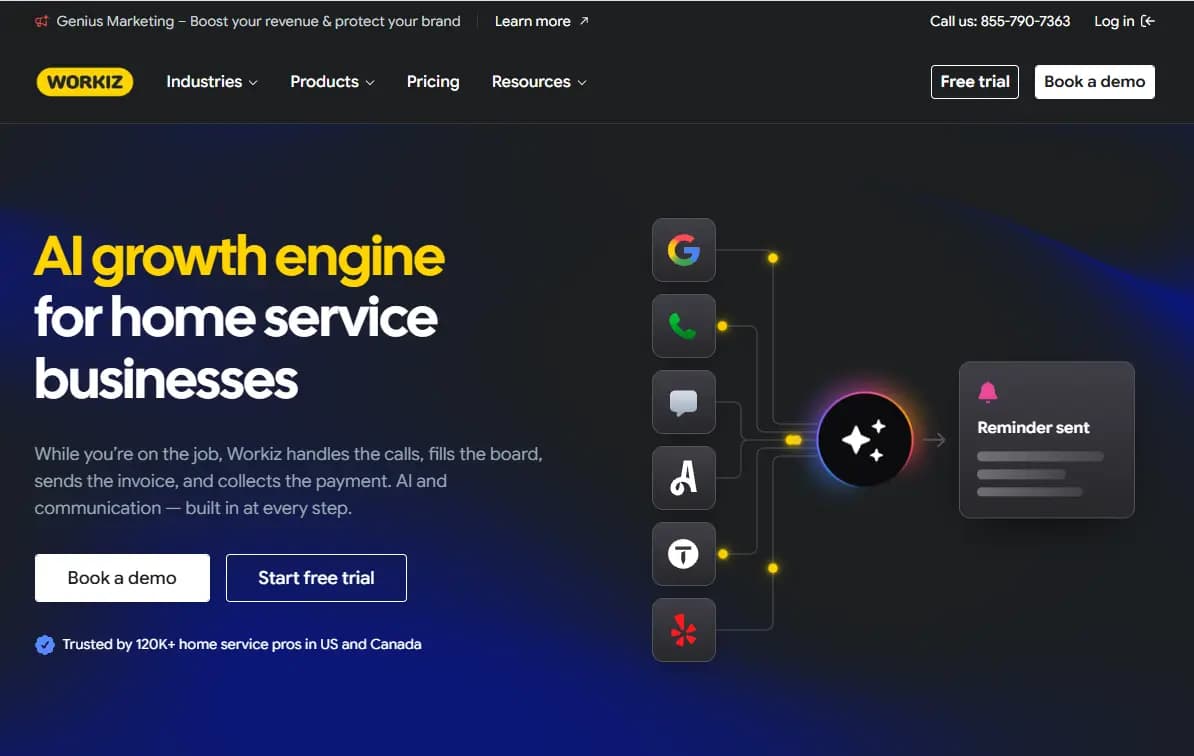
Workiz is built for growing home service businesses that want the power of an enterprise platform without the complexity. Where ServiceTitan is often criticized for its steep learning curve and long implementation, Workiz is designed so office staff and technicians can pick it up quickly, and G2's FSM index (July 2026) backs that up with an 8.7 for ease of setup and 9.2 for product direction.
The key difference in 2026: Workiz's communication and AI stack is native. Calls, texts, AI answering, marketing campaigns and reputation management are built-in products, not partner integrations that can expire.
Key features:
Genius Answering: AI answering across phone, SMS, email, webforms and lead sources, with full AI dispatching
Genius Phone: embedded phone system with call recordings, transcripts, AI insights, smart messaging, call masking and routing
Genius Marketing: campaigns that use live job data, plus reputation management that flags bad reviews as they hit
Smart scheduling and dispatching, inventory management, ad tracking (ROI), multi-day projects and multi-location support
Invoicing and payments, including card, mobile wallet, ACH and consumer financing
Automations for reminders, notifications and overdue invoice alerts
A mobile app that lets techs run jobs, invoice and get paid from the field
Where it shines: Growing home service teams in the complex trades (HVAC, plumbing, electrical, garage door, appliance repair, locksmith) that live on the phone and want communication, AI and field operations in one platform.
Where it fits less: Businesses that need enterprise-grade corporate hierarchy tools or large commercial project management. That end of the market is where ServiceTitan plays.
Pricing: Flexible, transparent plans tailored to your business needs. For current rates and plan details, visit the Workiz pricing page. Trusted by 120,000+ home service pros across the US and Canada.
2. Housecall Pro
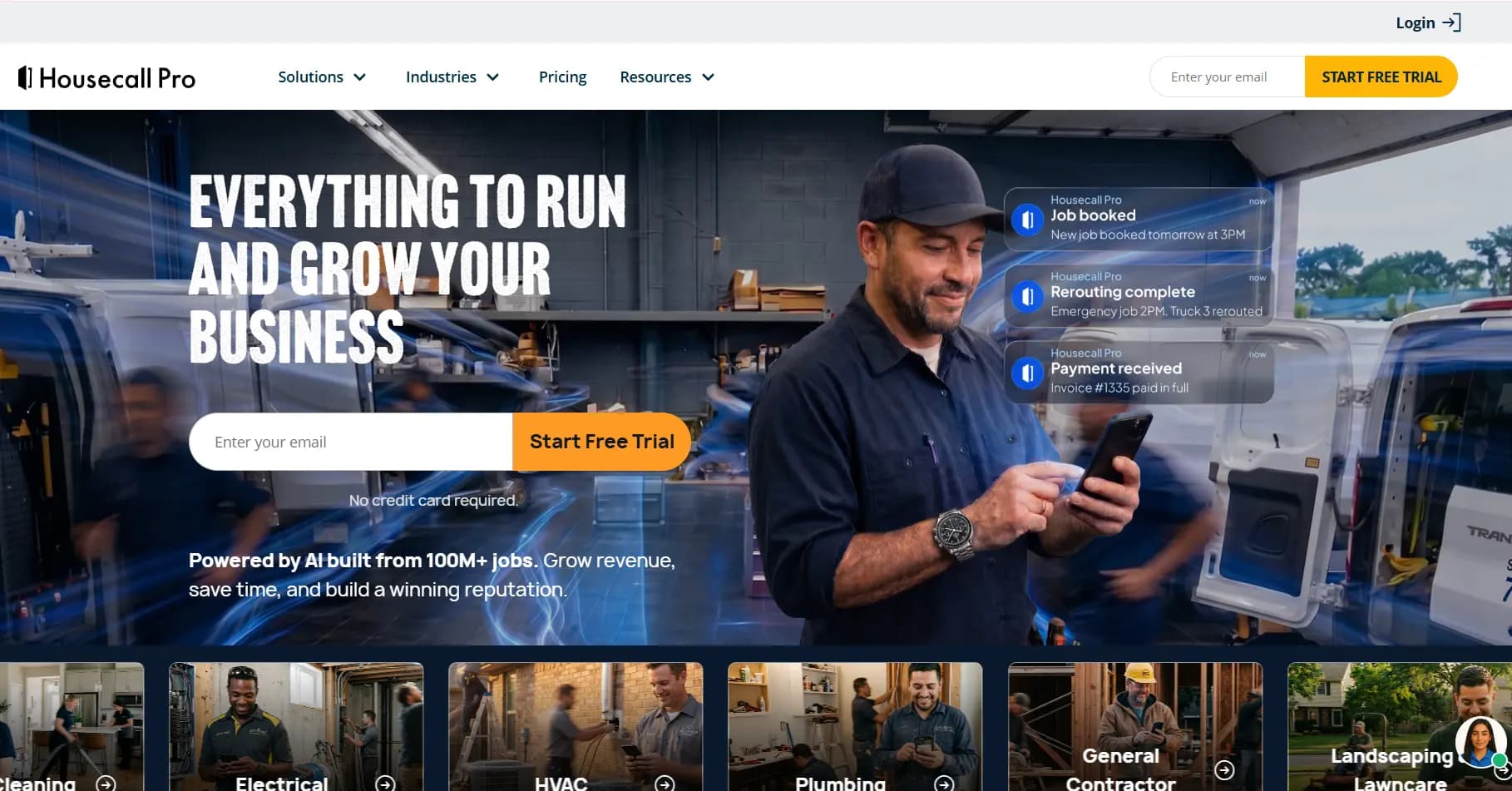
Housecall Pro is one of the most established names in the space and a genuinely strong product for small to mid-sized teams. In G2's FSM index (July 2026) it actually edges Workiz on ease of admin (9.1 vs 9.0) and ties on quality of support (8.7), which says a lot about how polished the day-to-day experience is.
Key features: Scheduling and dispatching, a phone system, AI answering for calls, marketing suite, client portal, pricebook, and multi-day and multi-location support.
Where it shines: Ease of administration and a clean, approachable experience for small teams.
Where it fits less: Shops with three or more techs that want deeper AI. Housecall Pro's AI answering covers phone only, while Workiz's covers phone, SMS, email, webforms and lead sources with full AI dispatching. Its phone system also lacks call insights, and online booking is limited. See the full Workiz vs Housecall Pro comparison.
Pricing: Tiered monthly plans starting around $49/mo for one user, scaling to ~$229+/mo for full features.
3. Kickserv
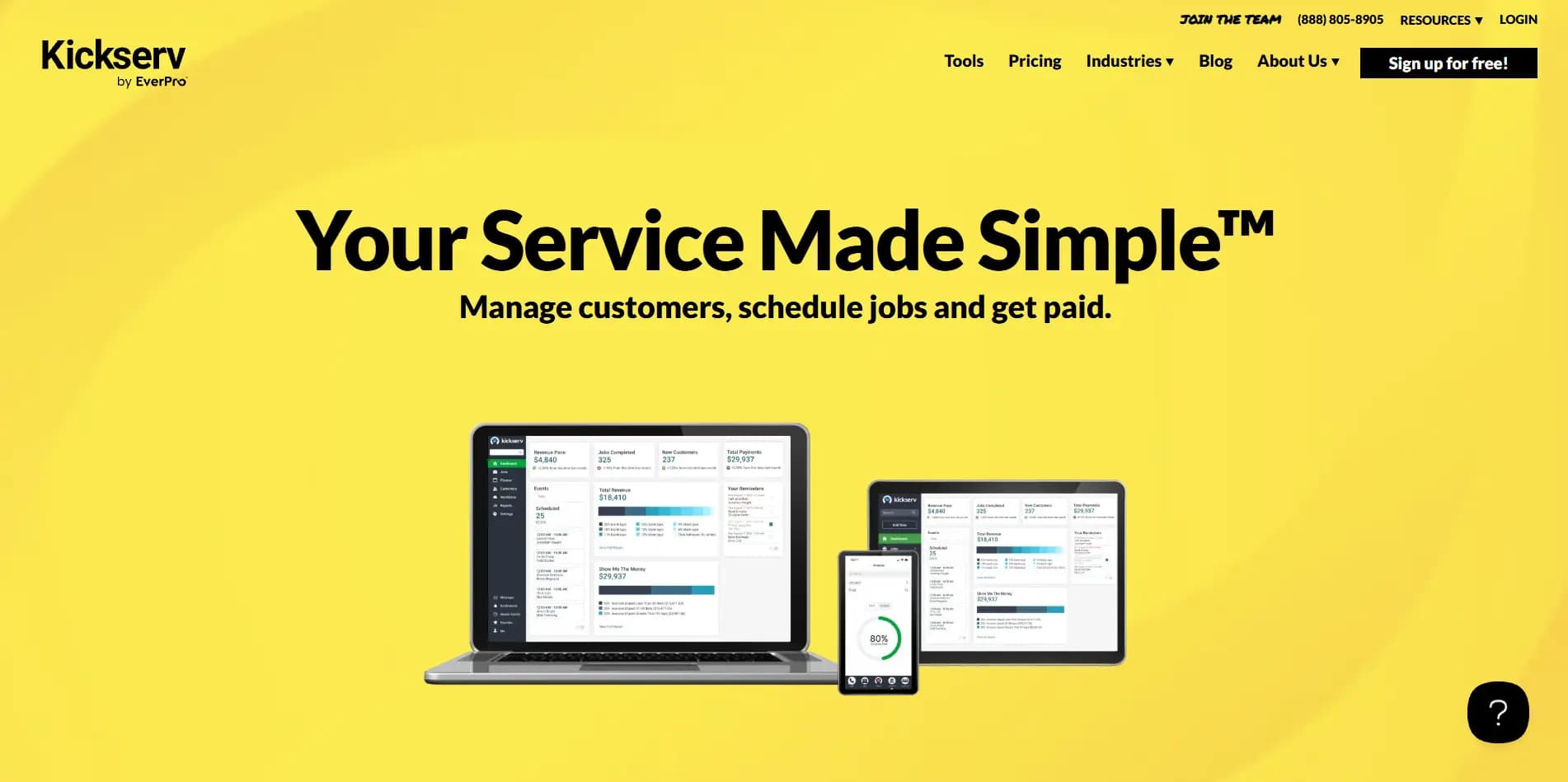
Kickserv is a straightforward, budget-friendly FSM for field and home service businesses. It covers the essentials that matter to a small operation at one of the lowest entry prices in the category.
Key features: dispatching, scheduling, a mobile app for the field, and a free trial to test it out.
Where it shines: small teams that want simple job management at a low monthly cost without committing to a bigger platform.
Where it fits less: everything around the jobs. There's no communications suite, no automations, no online booking, no Angi and Thumbtack integrations, and online payments are very limited. Teams that grow past basic scheduling tend to outgrow it. See the Workiz vs Kickserv comparison.
Pricing: starting at $47/mo, with a free trial.
4. FieldPulse
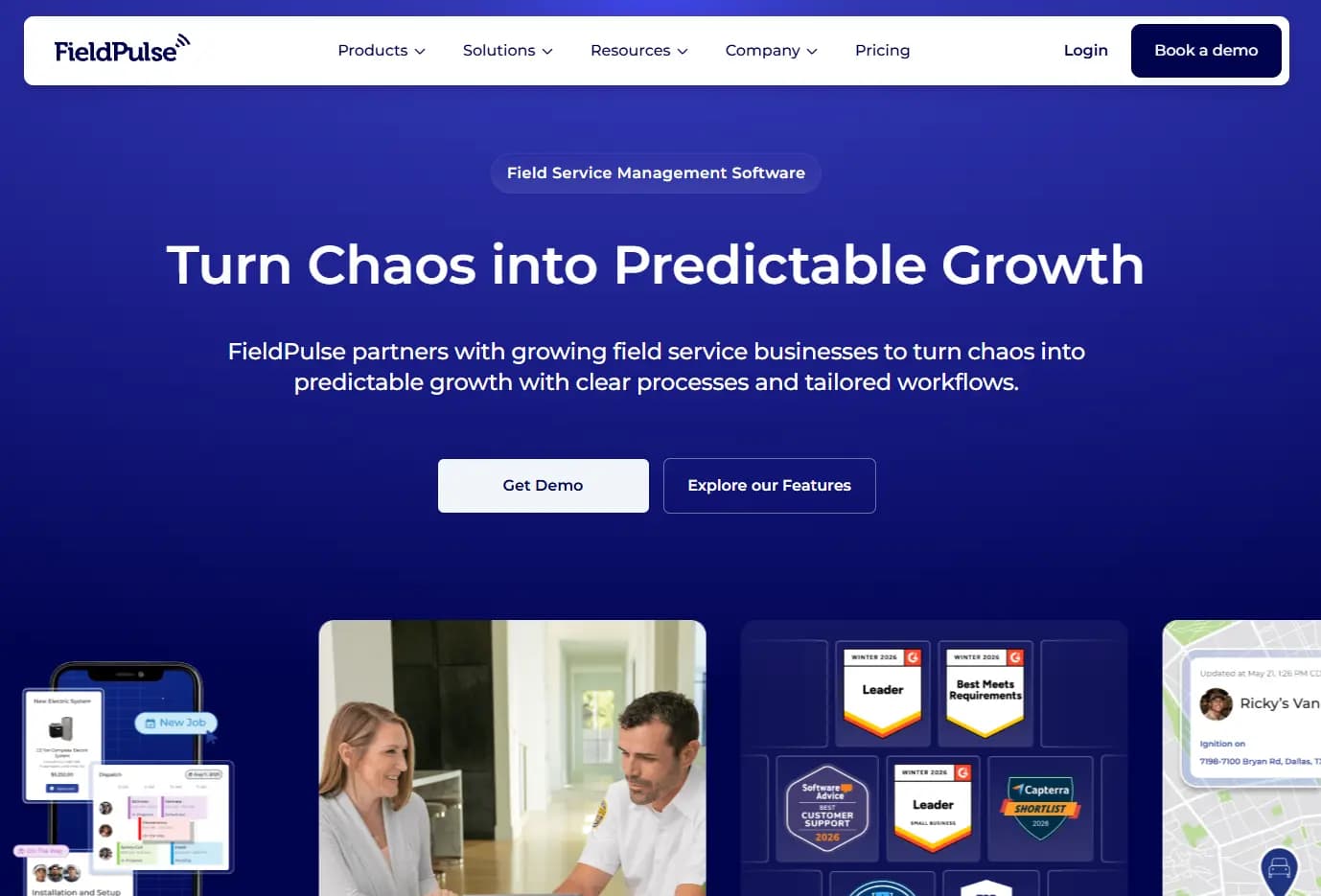
FieldPulse is a mobile-first platform for plumbing, HVAC and electrical businesses that emphasizes simplicity. It slightly outscores Workiz on G2 for ease of admin (8.9 vs 8.7) and is close on ease of setup (8.6 vs 8.7), so for pure day-to-day administration it holds its own.
Key features: Scheduling, offline-capable mobile app, on-site estimates with digital signatures, job costing and a built-in CRM.
Where it shines: Field-heavy teams that live in the mobile app and want a straightforward admin experience.
Where it fits less: Value for money and switching costs. FieldPulse averages $111 per user/month with a $1,500 migration fee and no free trial, versus $54 per user, $0 migration and a free trial with Workiz. See the Workiz vs FieldPulse comparison.
Pricing: Around $111 per user/month, $1,500 migration fee, no free trial.
5. Service Fusion
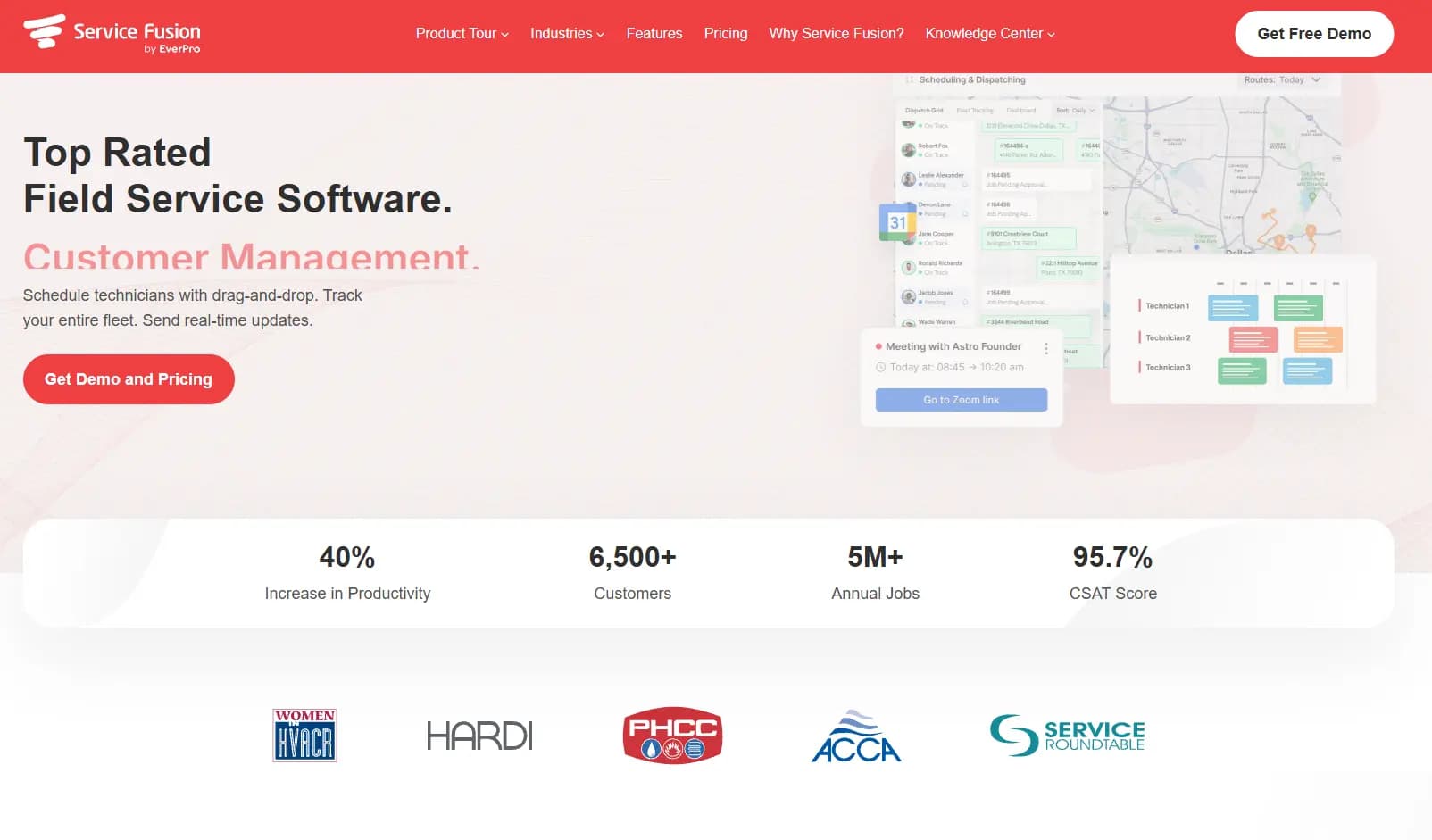
Service Fusion is a dependable legacy system that handles the fundamentals well: scheduling, dispatching, invoicing, pricebook, checklists, sales proposals, service plans and QuickBooks integration, plus consumer financing.
Where it shines: Businesses that want a proven system for the basics, with flat-rate pricing and unlimited users that appeal to larger headcounts on a budget.
Where it fits less: The growth layer. There's no embedded phone system with AI insights, no AI answering, no marketing suite or reputation manager, and automations and the client portal are limited. G2 (July 2026) also rates Workiz higher on ease of use (8.8 vs 8.6), ease of setup (8.7 vs 7.9) and support (8.7 vs 8.4). See the Workiz vs Service Fusion comparison.
Pricing: Flat monthly tiers regardless of headcount, starting around $208-250/mo.
6. Jobber
Jobber is one of the best entry points into FSM software, and genuinely great for simple-route businesses like lawn care and pools. It's simple, affordable and quick to learn, with a solid client portal, marketing suite and pricebook.
Where it shines: Solo operators and small crews with straightforward, route-based work going from pen and paper to organized scheduling and invoicing.
Where it fits less: The complex trades. For HVAC, plumbing, electrical, garage door, appliance repair and locksmith work, where you're dispatching techs, running multi-day projects, tracking parts and living on the phone, Jobber has no built-in phone with AI answering, no inventory management, no ad tracking or sales proposals, and multi-day projects, service areas, automations and service plans are limited. See the Workiz vs Jobber comparison.
Pricing: Tiered plans starting around $39/mo for one user; additional users cost extra on higher tiers.
7. FieldEdge
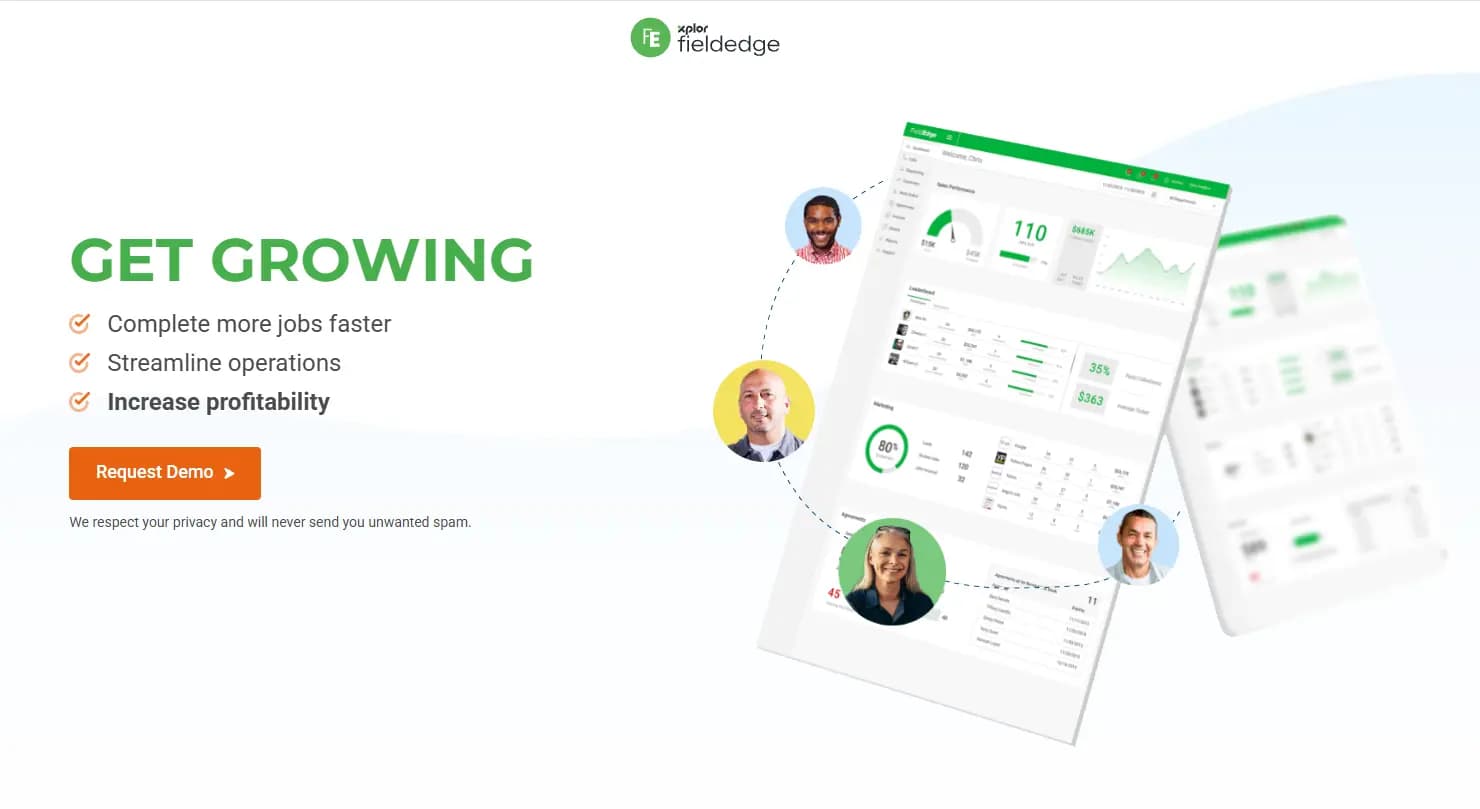
FieldEdge focuses on HVAC, plumbing and electrical contractors, and is best known for its QuickBooks integration, supporting both QuickBooks Online and Desktop. It covers dispatching, sales proposals, service plans, checklists and a pricebook.
Where it shines: Accounting-led operations, especially shops committed to QuickBooks Desktop, which many modern platforms don't support.
Where it fits less: Growth tools. FieldEdge records your business but won't answer the phone, chase the estimate or watch your reviews: there's no phone system, AI answering, messaging inbox, online booking, marketing suite or reputation manager, and automations are a paid add-on. It also carries a $500 onboarding fee and scores below Workiz on G2 for ease of use (7.9 vs 8.8) and ease of setup (7.2 vs 8.7). See the Workiz vs FieldEdge comparison.
Pricing: Quote-based tiers, plus a $500 onboarding fee.
Switching From ServiceTitan: What It Actually Involves
Fear of migration keeps a lot of businesses on software that no longer fits. Here's what the move to Workiz looks like in practice:
You export, Workiz imports: You export your data from ServiceTitan, and the Workiz support team handles the import.
What moves over: jobs, clients, invoices, inventory and more. If it can be exported from ServiceTitan, Workiz can bring it into the migration process.
Timeline: once the export is ready, the Workiz import is almost fully automated. The main timing variable is how quickly you can get your data out of ServiceTitan.
Cost and downtime: no migration cost and no planned downtime. Your business keeps running while the data is imported.
Support after the switch: a dedicated onboarding manager builds Workiz around your trades and workflow, and Workiz Live Academy sessions get your crew up to speed.
For a side-by-side breakdown, see the Workiz vs ServiceTitan comparison page.
Finding the Right Fit for Your Growth
For growing home service teams that want everything built in: Workiz, with native AI answering, phones, marketing and automations in one platform your team can learn quickly.
For enterprise scale and commercial projects: ServiceTitan remains the strongest option.
For solo operators and simple routes: Jobber is a solid, affordable entry point.
For simplicity-first small teams: Housecall Pro is polished and easy to administer.
For big headcounts on flat pricing: Service Fusion's unlimited-users model stands out.
For QuickBooks Desktop shops: FieldEdge is built around accounting.
For mobile-first admin: FieldPulse holds its own, at a higher price point.
The best software isn't the one with the most features on paper. It's the one your technicians will actually use, your office can navigate without frustration, and your budget can sustain as you scale. And after August 2026, add one more test: make sure the features you depend on every day are actually part of the platform, not someone else's partnership.