
How much does a HVAC technician make?
How much do HVAC people make on average? The average salary for an HVAC technician in the United States is $65,635 per year (as reported by ZipRecruiter in February 2026, based on job postings and salary data), or about $31.56 per hour. This figure reflects real-market averages, often including overtime and bonuses—common in the field. For comparison, the official hvac median salary according to the BLS (May 2024, still current) is $59,810 per year ($28.75/hour), showing solid earning potential with room for growth through experience and certifications.
Here’s a quick snapshot of typical pay ranges:
Percentile / Level | ZipRecruiter Annual Salary | ZipRecruiter Hourly | BLS Annual Wage (2024) | BLS Hourly Wage |
|---|---|---|---|---|
90th Percentile (Top) | $87,500 | $42 | $91,020 | $43.76 |
75th Percentile | $75,000 | $36 | $74,820 | $35.97 |
Average / Median | $65,635 (mean) | $31.56 | $59,810 (median) | $28.75 |
25th Percentile | $53,000 | $25 | $48,080 | $23.12 |
10th Percentile | N/A | — | $39,130 | $18.81 |
This snapshot highlights strong earning potential in a growing field. Individual pay can rise significantly with experience, advanced certifications, and strategic career choices—always cross-check local job listings for the most accurate picture in your area.
So, the question is: Have you ever considered a career in the thriving HVAC industry but wondered about the pay potential? You're not alone. Understanding HVAC technician salaries is necessary for anyone weighing career paths or negotiating their worth in this growing field.

Factors influencing HVAC technician salaries
Technician salaries in 2026 rise and fall just like the temperatures they manage. If you are researching how much do hvac techs make, remember that national averages and experience levels only provide a starting point. A specific set of factors determines your actual paycheck. This includes your location, the certifications you hold, your niche specialization, and current industry demand.
HVAC tech average salary by years of experience
Just as temperatures rise and fall, so too do technician salaries. While the median income paints a decent picture, a tapestry of factors weaves the intricate details of individual paychecks. Let’s explore the key elements shaping the financial landscape for these skilled professionals. Workiz makes sending estimates in the field an easy process, helps HVAC businesses collect payments, manage your job scheduling, online booking, and more, visit our features page to learn more.
Location
Location, location, location. Just like property, location heavily influences an HVAC technician’s salary. Metropolitan areas with sweltering summers and icy winters see a higher demand for skilled hands, translating to higher wages compared to rural areas with milder climates. California and New York, for example, boast significantly higher median salaries than states like Oklahoma or Montana.
Experience counts
Time spent honing your craft has its rewards. Entry-level technicians, fresh out of training, naturally earn less than veterans with years of experience under their belts. As skills and knowledge accumulate, so does earning potential.
Senior technicians with a decade or more of experience can command significantly higher salaries, often leading teams or specializing in complex systems.
Education & certification
Knowledge paves the path to higher pay. Holding a relevant associate’s degree or completing an apprenticeship program can give you an edge in the competitive job market, potentially boosting your starting salary and opening doors to higher-paying positions.
Industry niche
Not all HVAC is created equal. When comparing a general technician to a specialist, the air conditioner salary for those focusing solely on residential cooling units might differ from those handling complex industrial chillers. Specialization in specific areas like commercial or industrial systems, compared to residential work, opens doors to higher paychecks. Commercial and industrial systems are typically more complex and demanding, requiring specialized knowledge and skills, justifying higher compensation for technicians who tackle them.
Employer type
Who signs your paycheck also matters. Large corporations and unionized workplaces generally offer more competitive salaries and benefits packages compared to smaller, non-unionized businesses. Consider the reputation and size of the company you’re considering to gauge potential pay and career advancement opportunities.
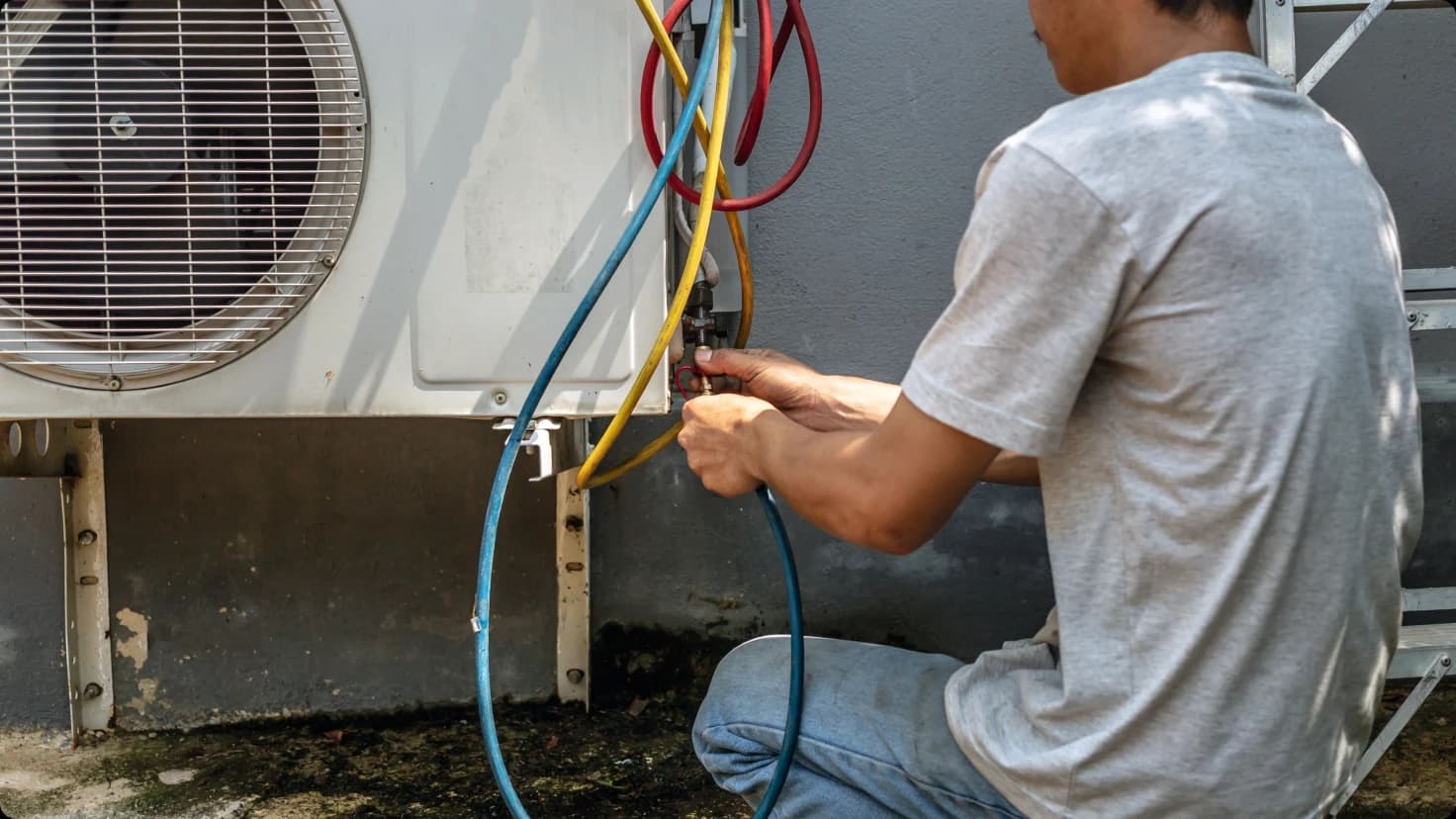
In 2026, the HVAC field continues to offer excellent job security and strong earning potential thanks to growing demand for energy-efficient systems, climate control upgrades, and ongoing construction projects. Whether you’re switching careers, entering the workforce after high school, or looking to upskill, the path is accessible and hands-on focused. Most technicians start with basic education and quickly move into paid apprenticeships or entry-level roles while building certifications.
Here is a detailed guide on how to become an HVAC technician:
Earn your high school diploma or equivalent
If you’re looking for a stable, in-demand career with good earning potential, becoming an HVAC technician is a great option. HVAC technicians are responsible for installing, maintaining, and repairing heating, ventilation, and air conditioning (HVAC) systems in residential and commercial buildings.
There are several educational paths you can take to become an HVAC technician. The most common options include:
Certificate program. These programs can be completed in as little as six months and cover the basics of HVAC systems, troubleshooting, and repair.
Associate degree. An associate degree program in HVAC or a related field, such as refrigeration or engineering, takes about two years to complete and provides a more comprehensive education.
Apprenticeship. An apprenticeship program combines on-the-job training with classroom instruction. Apprenticeships typically last four years and lead to journeyman status, which is required in some states to obtain a license.
No matter which educational path you choose, you’ll need to have strong math and mechanical skills. You should also be able to work independently and solve problems effectively.
Certification and licensing
In addition to your education, you may also need to obtain state or local licenses or certifications. The specific requirements vary depending on where you live.
Once you have the necessary education and qualifications, you can start looking for a job as an HVAC technician. There are many job openings available in this field, so you should be able to find a good position with relative ease.
Think of it as a voluntary skill badge, showcasing your expertise in specific areas. While not always mandatory, it’s highly recommended for several reasons:
Boosted confidence. Earning a recognized certification like NATE (North American Technician Excellence) demonstrates your proficiency, giving you an edge in competitive job markets.
Skill specialization. Want to be a refrigeration guru or an air conditioning ace? Certain certifications focus on specific areas, allowing you to tailor your expertise and command higher rates for specialized services.
Networking opportunities. Many certification programs host events and connect certified technicians, broadening your professional network and potential job leads.
Licensing
This is the official thumbs-up from your local authorities, granting you the legal right to work as an HVAC technician in your specific state or province. Requirements vary but generally involve:
Passing an exam. This tests your knowledge of local codes, safety regulations, and technical skills. Prepare well, as this is your gateway to practicing professionally.
Meeting experience requirements. Some states may require a minimum amount of supervised on-the-job experience before you can take the licensing exam. This ensures you’re ready to tackle real-world challenges.
Paying applicable fees. Be prepared for application and licensing fees associated with the process.
Navigating the process
Research your local requirements. Contact your state or provincial licensing board to understand the specific steps and documents needed for both certification and licensing.
Choose your certification focus. Decide on your desired area of expertise and select the relevant certification program. Popular options include NATE for general HVAC and EPA 608 for refrigerant handling.
Prepare for exams. Invest in study materials, attend prep courses, and practice mock exams to ensure you’re well-equipped for the official tests.
Gather documentation. Compile proof of education, experience, and any required prerequisites for certification and licensing applications.
Submit your application and fees. Fill out the forms meticulously and pay the necessary fees to initiate the process.
Importance of apprenticeship and on-the-job training
In today’s rapidly evolving job market, traditional classroom learning often struggles to keep pace with the ever-changing needs of employers and industries.
This is where apprenticeships and on-the-job training (OJT) come in as crucial pathways to developing a skilled and adaptable workforce.
Needed hands-on experience
Apprenticeships and on-the-job training are the crucibles where theoretical knowledge melds seamlessly with the practical intricacies of HVAC systems. Textbook understanding finds its resonance when faced with the humming components and intricacies of real-world heating and cooling setups.
The hands-on experience gained during apprenticeships serves as a touchstone for technicians, allowing them to troubleshoot, repair, and install with the confidence born of tangible encounters with HVAC challenges.
Many HVAC technicians begin their careers through apprenticeship programs, which often combine classroom instruction with hands-on training. These programs, typically lasting 3 to 5 years, provide a holistic understanding of HVAC systems.
On-the-job training further hones skills, as technicians troubleshoot, repair, and install under the guidance of experienced mentors.
Guided mentorship
The mentor-mentee dynamic woven into apprenticeships provides an invaluable scaffold for fledgling technicians. Seasoned professionals, having weathered the storms of diverse HVAC scenarios, become beacons of wisdom for those navigating the labyrinth of the trade.
The direct guidance and insights imparted by mentors during on-the-job training not only accelerate the learning curve but also nurture a nuanced understanding of the intricate machinery and systems at play.
Real-time problem-solving
The HVAC landscape is rife with scenarios where textbook solutions pale in comparison to the nuanced challenges posed by actual systems. Apprenticeships and on-the-job training expose technicians to the unpredictable nature of real-world HVAC issues.
This exposure cultivates adaptive problem-solving skills, an indispensable trait for professionals grappling with the dynamic nature of heating, ventilation, and air conditioning systems.
Cultivation of technical dexterity
The hands-on nature of apprenticeships and on-the-job training serves as an anvil upon which the technical dexterity of HVAC technicians is forged. The delicate calibration of thermostats, the intricate dance of refrigerants, and the meticulous installation of ventilation systems become not just theoretical.

Entry-level to master technician salary
The journey from an entry-level technician to a seasoned master is paved with learning, experience, and, of course, increasing pay. But just how much does a technician’s salary climb as they ascend the skill ladder? Let’s explore the exciting trajectory of earnings in various technical fields.
Average salary range by years of experience
Factors affecting entry-level salaries
Stepping into your first professional role brings a mix of excitement and curiosity. Among the many questions swirling in your mind, “What salary can I expect?” likely holds a prominent position. While there’s no crystal ball with a definitive answer, understanding the factors that influence entry-level salaries can shed some light on this crucial aspect of your career launch.
Education and qualifications
Your academic background plays a significant role. Holding a relevant degree or diploma often translates to a higher starting salary. The prestige of your institution and specialization can also add notes to the melody.
Experience and skills
Even before your official job title, relevant experience, internships, or volunteer work can boost your value. Demonstrating practical skills and a proactive approach can make you stand out from the crowd, leading to a sweeter tune in your paycheck.
Industry and field
The field you choose plays a major role. Some industries, like tech or finance, are known for higher salaries, while others, like non-profit or social work, may offer lower base pay but compensate with other benefits or intrinsic rewards.
Location and cost of living
Where you land impacts your salary significantly. Big cities with high living costs usually offer higher wages to attract and retain talent, while smaller towns may have lower salaries but also lower expenses.
Company size and culture
The size and culture of your employer can influence your starting pay. Large corporations often have established salary structures and may offer higher base salaries, while smaller startups may offer lower initial pay but compensate with equity or faster career growth potential.
Negotiation skills
Don’t underestimate the power of negotiation! Researching industry norms, preparing your arguments, and confidently advocating for your worth can lead to a more harmonious financial accord.
Average HVAC technician by state
Salaries for HVAC technicians vary widely across the United States, influenced by factors like cost of living, climate demands, local job market, and union presence. The figures below represent average annual and hourly pay as of early 2026, with higher wages typically in states with extreme weather or high living costs.
These figures are refreshed for early 2026 and sourced primarily from ZipRecruiter, cross-referenced with U.S. Bureau of Labor Statistics (BLS) May 2024 occupational employment and wage data for Heating, Air Conditioning, and Refrigeration Mechanics and Installers. Salaries can vary based on experience, certifications (e.g., NATE, EPA 608), overtime, union status, urban vs. rural location within the state, and current job market conditions—always verify with local listings or employers for the most accurate picture.
Conclusion
The HVAC industry in 2026 remains one of the most stable and rewarding skilled trades, with a national average salary of $65,635 and strong upward potential for those who invest in experience, certifications like NATE and EPA 608, and specialization in high-demand areas like commercial systems or energy-efficient tech. From entry-level roles starting around $40,000–$65,000 to master technicians exceeding $100,000 in top markets, earnings grow steadily—driven by persistent labor shortages, ongoing construction, retrofits, and the push for sustainable buildings.
With BLS projecting 8% job growth through 2034 (much faster than average) and tens of thousands of annual openings, the demand for qualified HVAC technicians shows no signs of slowing. Whether you’re just starting out via apprenticeships and hands-on training or advancing your career, the path offers job security, practical skills, and real financial rewards in a field that’s essential year-round.
For HVAC business owners and technicians, tools like Workiz can help streamline estimates, scheduling, payments, and daily operations—freeing up more time to focus on growing income and delivering excellent customer service in this thriving sector.