
Every HVAC owner hits the same cash wall when shoulder season lands. When summer ends, the phones go quiet, but truck payments, payroll, and warehouse rent do not shrink with them, whether you run 5 technicians or 50.
Relying purely on weather spikes to trigger emergency repairs leaves your net margins vulnerable.
Structured service agreements smooth that swing by locking in steady recurring payments, filling slow seasons with billable work, and keeping past customers from defecting to competitors.
Why HVAC Businesses Struggle With Unpredictable Revenue
Running on break-fix calls alone is exhausting. One quarter you’re short on trucks. The next, an empty dispatch board has you doing payroll math.
Seasonal Peaks Strain Techs and Budgets: July hits 95 degrees and the board blows up. Techs burn out in hot attics, overtime eats your summer profit, and any call the office misses goes to the shop down the road.
Slow Months Leave Techs Idle: October brings 68 degrees and quiet thermostats. Trucks sit in the yard while insurance, leases, software, and rent keep coming. You pay techs to wait or cut hours and watch your best ones walk.
One-Time Customers Leave No Recurring Base: Ads cost real money to get a truck in the driveway. Your tech swaps a capacitor and leaves. Two winters later the furnace quits, and the homeowner clicks the first local ad instead.
What Are HVAC Service Agreements and What Should They Include?
An HVAC service agreement is a contract where a customer pays a recurring fee for scheduled tune-ups and member benefits, and you get booked work and a customer who stays with you. Contractors can build the inspection checklist on ACCA’s ANSI-recognized maintenance standard, ACCA 4 QM. A strong one has five parts, covered in the table below.
Component | What to Put in the Agreement | What Each Side Gets |
Scheduled Preventive Maintenance Visits | One or two visits a year, booked before each season | Customer: Serviced equipment. You: Booked slow-month work. |
Equipment Inspections and Performance Checks | A written checklist covering filters, coils, refrigerant, and electrical, with results logged | Customer: Early problem detection. You: A record of system age. |
Priority Scheduling and Emergency Service Benefits | Members booked first, with a reduced or waived dispatch fee | Customer: Faster help. You: A reason to renew. |
Repair Discounts and Member-Only Perks | A capped, fixed repair discount, plus any loyalty pricing | Customer: Lower repair costs. You: Loyalty without constant discounting. |
Contract Terms, Exclusions, and Renewal Policies | Term length, billing cycle, exclusions, and renewal and cancellation rules | Customer: No surprises. You: Predictable renewals, fewer disputes. |
How to Build and Sell Profitable HVAC Maintenance Plans
Profitable maintenance programs require smart plan design, clear field sales training, and an eye toward future equipment replacements.
How to Design Plans Customers Say Yes To
If a customer can’t understand the plan in one phone call, they won’t buy it.
Offer Three Clear Tiers: Basic covers one tune-up, Standard adds a second visit and discounts, and Premium adds priority perks.
Price Each Visit for Profit: Add tech time, drive time, truck costs, and supplies. Owners often forget the drive. Price the plan above that total, discounts included.
Add Priority Service and Repair Discounts: Front-of-line scheduling and a flat repair discount give members a benefit they feel the day something breaks.
Set Visit Schedules and Renewal Terms: Book spring and fall visits on a 12-month term and spell out renewal and cancellation rules.
How to Sell Plans on Calls and Job Sites
Technicians and dispatchers are your primary sales engine. If they view maintenance agreements as extra paperwork, your membership numbers will stall.
Channel | Who and When | What to Say |
Pitch Plans at the Job Site | Tech, after finishing the repair | “I can enroll you today and book your next tune-up before the season.” |
Offer Plans on Inbound Calls | Office team, when booking a repair or tune-up | “Many customers add our maintenance plan when they book. Want me to include it?” |
Contact Past Customers First | Owner or office, starting with recent installs and repeat callers | “It’s been a year since your last visit. Members get priority scheduling, so I wanted to offer you a spot.” |
How Tune-Ups Feed Your System Replacement Pipeline
A tune-up puts a tech in front of a system you’d otherwise never see, which makes it your earliest read on what’s about to fail.
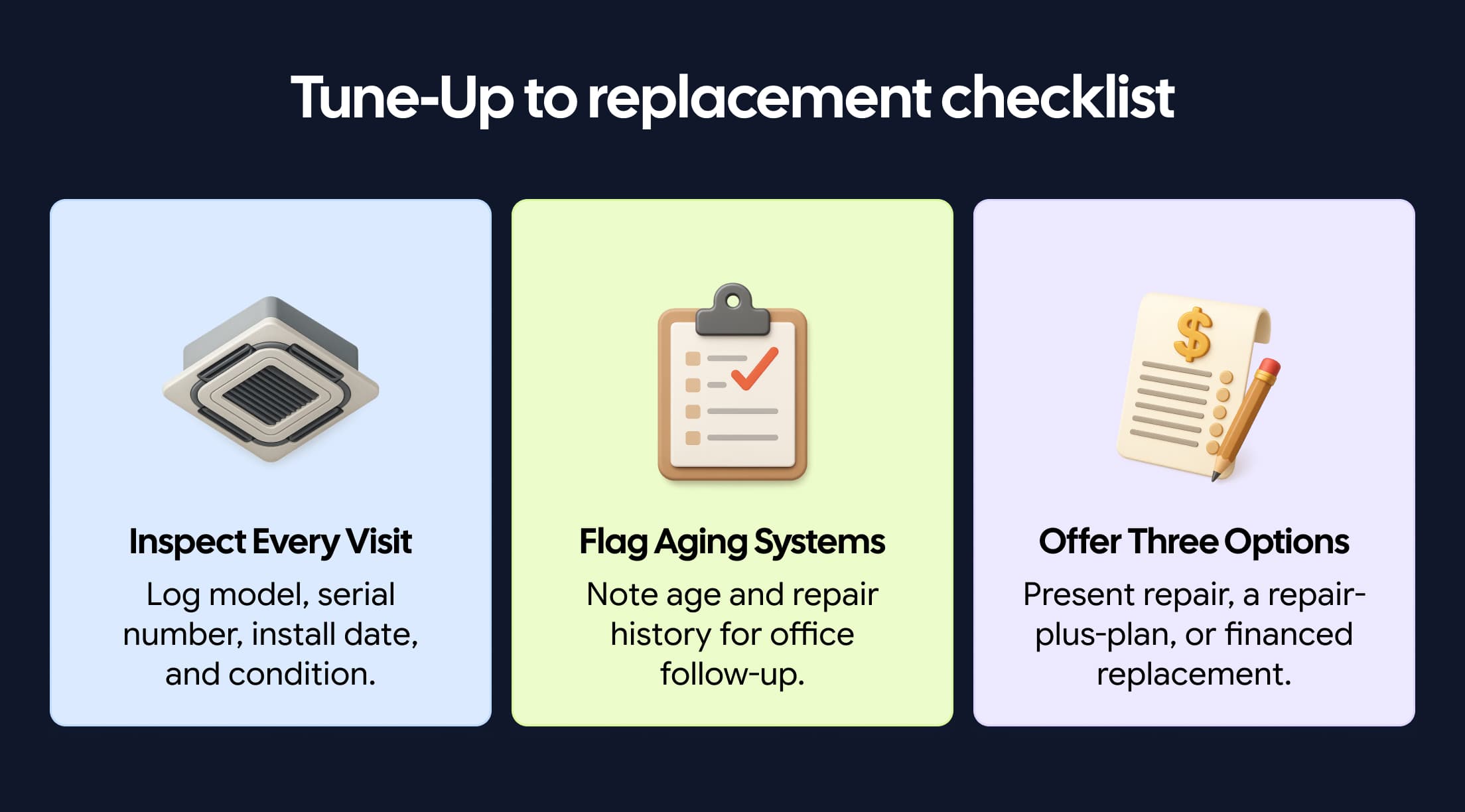
Inspect Equipment on Every Visit: Log the model, serial number, install date, and condition each time, using the same checklist. A system nobody looked at is a lead nobody followed up on.
Flag Aging Systems in Job Notes: Note which systems are getting old so the office can follow up. ENERGY STAR suggests considering replacement when an air conditioner or heat pump is more than 10 years old, a furnace or boiler is more than 15 years old, or equipment needs frequent repairs while energy bills climb.
Present Good/Better/Best Options and Financing: When an aging unit needs costly repairs, present three options: basic repair, a repair bundled with a service plan, or a full replacement. Pair options with financing. It makes the bigger option easier to approve in the same conversation.
How to Manage HVAC Service Agreements and Automate Renewals
Selling plans is half the job. The other half is making sure visits, payments, and renewals don’t slip through the cracks.
Schedule Visits Before the Season Starts: Book AC checks in March and heating tune-ups in September. Batch appointments geographically to cut drive time and keep techs billable before the rush hits.
Bill Members on a Set Cycle: Set up automated monthly card charges. You avoid chasing unpaid invoices, smooth your working capital, and reduce cancellations.
Remind Members Before Visits and Renewals: Send automated SMS texts two weeks and two days before scheduled visits. Automated reminders cut phone tag and no-shows, and a reminder ahead of renewal gives members time to update an expiring card.
HVAC Service Agreement Best Practices and Metrics
A plan nobody tracks quietly loses money. Check these four practices on a regular schedule, and pair each with the number that shows whether it’s working.
Practice | What to Do | What to Track |
Cap Discounts to Protect Margin | Set a maximum repair discount and don’t stack it with other offers | Average margin on member jobs compared with non-member jobs |
Track Plan Count and Renewal Rate | Count active plans each month and watch how many renew | Active plans, and the percentage of expiring plans that renew |
Track Revenue per Member | Add plan fees, repairs, and replacement sales for each member | Total member revenue, divided by the number of members |
Review Lapsed Plans Every Month | Call members whose plans expired or whose payments failed | Lapsed plans, the reasons, and how many you win back |
How Workiz Helps HVAC Businesses Run Service Agreements
Workiz is an all-in-one field service management platform trusted by 120,000+ field service pros. Scheduling, payments, and customer communication live in one place, which is what a service agreement program needs.
Service Plans for Visits, Billing, and Renewals: Set up your tiers once with service plans, then track each member’s visits, billing, and renewal date in the same system. You can see who’s due for a tune-up and whose plan is coming up for renewal without digging through spreadsheets. Service plans are included in the Ultimate plan.
Workiz Pay for Recurring Payments: Workiz Pay saves a member’s card on file and charges it automatically each billing cycle, so you’re not stuck chasing checks. One-time plan payments can also be collected by card or ACH, and every payment ties back to the member’s account.
Enroll Customers From the Mobile App: Your tech finishes the job and offers the plan right there in the driveway. The mobile app already handles estimates, invoices, and payments, so enrollment happens during the same visit.
Automated Reminders Before Each Visit: Workiz automations send reminders before each scheduled visit, plans can renew automatically, and owners can set it all up without technical expertise. Members show up ready, and your techs deal with fewer no-shows.
Genius Marketing to Sell Plans to Past Customers: Genius Marketing runs AI-powered email and text campaigns targeted by client job history. That’s how you reach customers who had a repair or an install but never joined a plan. Genius Marketing is an add-on, and once your client list is imported, a first campaign can go live in minutes, so you can be ready well before your next season.