![What is the best HVAC business software in [current_year]](/_next/image/?url=https%3A%2F%2Fa.storyblok.com%2Ff%2F292176025308856%2F50c6008c7f%2Fprofessional_hvac_repair_team_heating_cooling.webp&w=3840&q=75)
What is HVAC business software?
HVAC business software, also known as HVAC management software or HVAC service software, is a suite of digital tools designed specifically for heating, ventilation, and air conditioning companies. It integrates various business functions into one platform, helping manage everything from customer interactions to scheduling, invoicing, payments, price-books and flat rate catalogs, inventory levels, service plans, communications, AI & automations, warranties, equipment tracking, consumer financing, and field operations.
At its core, this software replaces outdated paper-based systems or fragmented apps with a unified system. Imagine dispatching technicians in real-time, generating invoices on-site, and tracking inventory—all from a single dashboard. In 2026, advancements in AI and cloud computing have made these platforms even more intuitive, with features like predictive maintenance alerts and automated customer follow-ups.
For HVAC professionals, the software acts as the central nervous system of the business. It handles HVAC scheduling software for appointments, HVAC dispatch software for routing, HVAC invoicing software for billing, and HVAC CRM software for relationship management. Larger firms might opt for comprehensive HVAC field service management software that scales with growth.
Evolution of HVAC software
HVAC software has come a long way since the early 2000s when basic dispatching tools dominated. Today, in 2026, integration with IoT devices allows real-time monitoring of HVAC systems, enabling proactive service. Cloud-based solutions ensure accessibility from any device, while mobile apps empower field teams to update job statuses instantly.
Core components: Scheduling, dispatching, invoicing, inventory, and reporting.
Advanced add-ons: AI answering, expense management, consumer financing, GPS tracking, customer portals, and AI-driven analytics.
Benefits for businesses: Reduced administrative time, fewer errors, and data-driven decisions.

Why HVAC companies need business software in 2026
In an era of digital transformation, ignoring HVAC business software is like driving without GPS – possible, but inefficient and risky. HVAC companies deal with seasonal demands, complex installations, and high-stakes maintenance. Manual processes lead to missed appointments, billing delays, and unhappy customers, eroding profits.
Market conditions also play a major role in HVAC business success. Factors like regional demand, labor availability, and operating costs can significantly impact growth potential. This analysis of the best and worst states to open an HVAC business provides additional context on how location influences long-term viability.
Here’s why modern HVAC firms can’t afford to skip it:
Streamlined operations and efficiency
HVAC scheduling software and dispatching software optimize routes, reducing travel time by up to 20%. Technicians arrive prepared with customer history and parts lists, minimizing callbacks. For growing companies, this scalability prevents bottlenecks as teams expand.
Improved customer experience
With HVAC CRM software, businesses can personalize services—sending automatic reminders for filter changes or upsell energy-efficient upgrades. Automated invoicing and payments via HVAC invoicing software speed up cash flow, while customer portals build trust through transparency. AI answering helps customers get instant service day or night, without the business needing to add 24/7 office staff.
Cost savings and profitability
Reporting tools in HVAC management software reveal insights like peak service hours or underperforming techs. Businesses report 15-25% cost reductions by cutting paper use, overtime, and errors. In 2026, with inflation pressures, these savings are crucial.
Compliance and data security
Regulations around refrigerant handling and energy efficiency demand accurate records.
For small businesses, the barrier to entry is low with affordable plans starting at $50/month. Larger contractors benefit from enterprise features like multi-day project management, and multi-location support.
How HVAC companies manage operations more efficiently in 2026
By 2026, many HVAC companies have outgrown generic field service tools. Managing technicians, customer communication, estimates, payments, and follow-ups across disconnected systems often leads to scheduling conflicts, delayed payments, and frustrated customers.
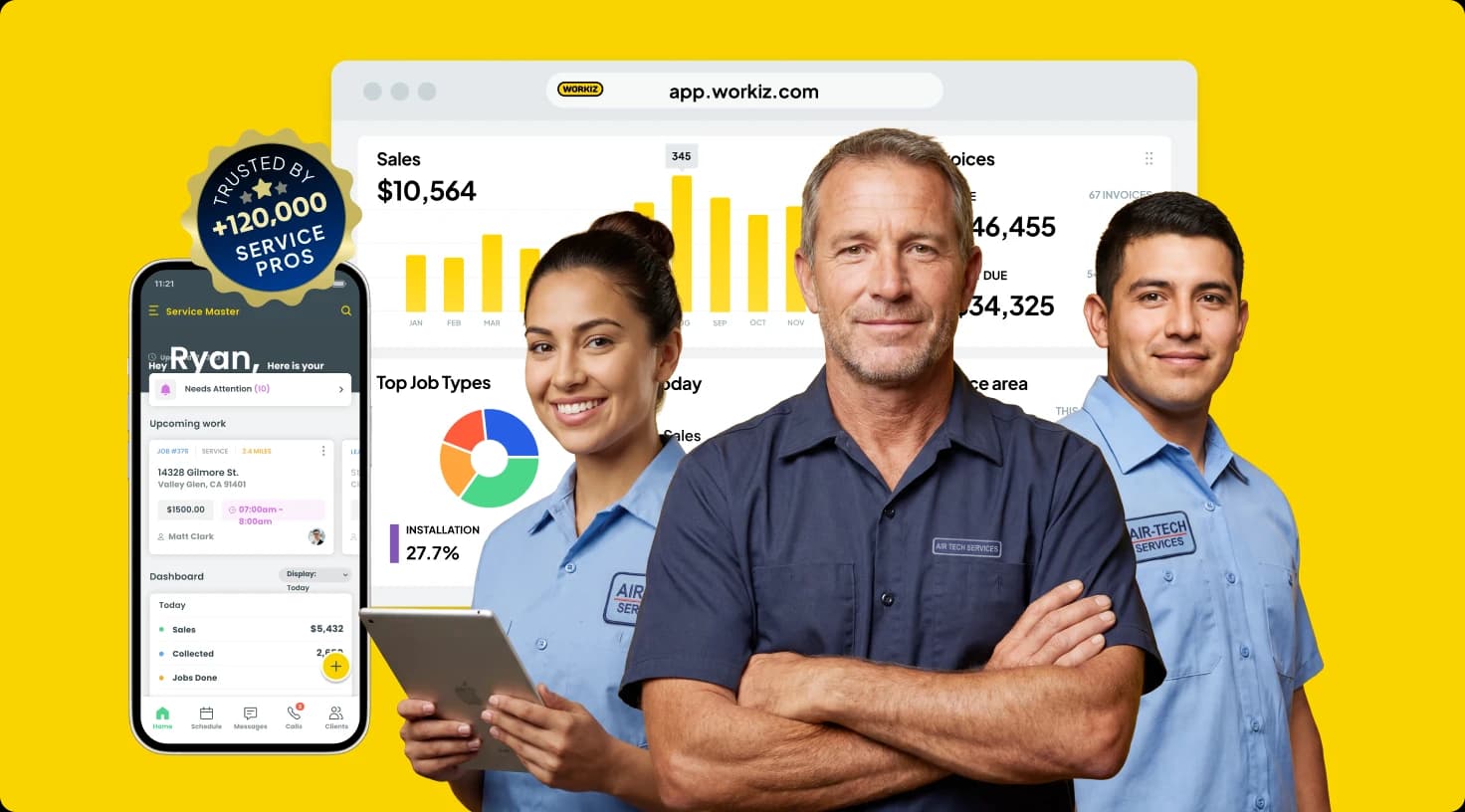
HVAC-focused platforms like Workiz HVAC software are designed around real HVAC workflows, helping service businesses manage daily operations from one centralized system instead of juggling multiple tools.
🗓️ Scheduling & dispatch Easily assign jobs, optimize technician schedules, and track field activity in real time.
💬 Customer communication Handle calls, texts, reminders, and "on-the-way" notifications from one built-in communication hub.
📄 Estimates & invoices Create professional estimates and invoices on-site or in the office, reducing paperwork and delays.
💳 Payments in the field Collect payments instantly using integrated payment processing, helping HVAC businesses get paid faster.
👷 Technician management Give technicians mobile access to job details, customer history, and updates while in the field.
📊 Business visibility Track jobs, revenue, and team performance with reporting designed for service-based businesses.
Because HVAC companies rely on software to support these operational needs every day, understanding which features matter most is the next step in choosing the right HVAC business software.
Key features to look for in HVAC business software
Choosing the best HVAC software means prioritizing features that align with your workflow. In 2026, expect AI enhancements like voice-activated dispatching and predictive inventory. Below, we break down essentials.
Smart scheduling & AI dispatching
HVAC scheduling software should offer drag-and-drop calendars, automated reminders, and conflict detection. HVAC dispatch softwares integrates GPS for optimal routing, real-time ETA updates, and technician skill matching. Look for mobile apps that allow on-the-go adjustments.
Drag-and-drop interface for easy rescheduling.
Integration with Google Calendar or Outlook.
Automated notifications via SMS/email.
Automated invoicing & payments
Why it matters: HVAC invoicing software must reduce friction between the job finish and payment. If techs can’t generate a professional invoice in 30 seconds on-site, you are losing cash flow.
Feature | Benefit | Example tools |
|---|---|---|
QuickBooks Integration | Syncs finances automatically | Workiz, ServiceTitan, FieldEdge |
Mobile Payments | Accept payments in the field | Workiz, Housecall Pro, FieldEdge |
Invoice Templates | Brand consistency | All major platforms |
CRM and customer management
Why it matters: Basic CRMs just store names. A Lead Intelligence CRM tracks customer history, equipment age, and warranty status.
AI Feature: Automated follow-ups. The system automatically emails a client 6 months after an install to schedule maintenance, increasing recurring revenue without manual work.
Customer portal: Allows clients to book their own appointments online, reducing office call volume.
Integrations and mobility
Why it matters: HVAC techs often work in basements or rural areas with poor signal.
The requirement: A native mobile app (iOS/Android) where technicians can upload photos, add line items, and collect signatures without data.
Pro tip for small businesses: Don’t overpay for “Enterprise” complexity. Prioritize ease of use and customer support. If your techs need a week of training to use the app, it's the wrong software.
While HVAC business software helps manage operations, technicians also depend on the right tools to perform their work efficiently in the field. If you're building a complete tech stack for your team, this guide to the best HVAC tools for service techs covers essential equipment that supports productivity, accuracy, and service quality.
Top HVAC business software options in 2026
The market is crowded, but a few stand out for their reliability and innovation. We’ll review the leading HVAC business software based on user reviews from G2 and Capterra, focusing on usability, scalability, and value.
Quick comparison
Feature | Workiz (Editor’s Choice) | ServiceTitan | Housecall Pro | FieldEdge |
|---|---|---|---|---|
Best For | Growing Teams (+3-50 Techs) | Enterprise (50+ Techs) | Solopreneurs (1–5 Techs) | Solopreneurs (2-6 Techs) |
Pricing | $187/month (incl. 3 users) Tiered Packages | High Cost ($350+ per tech) | Tiered Packages | $100/office user + $125/tech monthly, plus setup |
AI Features | Genius AI (AI answering and scheduling) | Advanced Analytics | Basic Automation | Predictive Analytics |
Ease of Use | ⭐⭐⭐⭐⭐ (Very High) | ⭐⭐ (Steep Curve) | ⭐⭐⭐⭐ (High) | ⭐⭐⭐ (Standard) |
Setup Time | Days | Months | Days | +-5 weeks |
Workiz
While most software simply digitizes paperwork, Workiz is built to help your team grow. It combines an intuitive experience with the power and flexibility required by enterprise teams. In 2026, its “Genius” AI features set it apart by automatically handling your missed calls and inbox messages 24/7, and by automating dozens or times consuming office tasks.
✔ Pros:
Revenue-boosting proposals: "Good, Better, Best" visual estimates are proven to increase ticket size by over 20%.
Workiz Genius Answering: An AI assistant that answers missed calls and books jobs when your team can't.
Inventory management: Tracks parts across multiple trucks and warehouses in real time.
Team visibility and accountability: Real-time dashboards give managers full insight into technician performance, job status, and revenue.
Scalable workflows for growing teams: Automations, permissions, and role-based controls support both small crews and large, multi-location operations.
✖ Cons:
Feature depth: Might be too powerful for a “one-man show” who just needs a simple invoicing app.
Best for: Residential & Commercial HVAC teams focused on scaling revenue without hiring more office staff.
Pricing: Flexible plans tailored to team size (Free Trial available).

ServiceTitan
ServiceTitan is a powerhouse for mid-to-large HVAC enterprises, offering end-to-end HVAC field service management software. Its robust dispatching and marketing tools help contractors scale efficiently.
Pros: Advanced analytics, call booking, inventory management.
Cons: Steep learning curve, higher pricing (starts at $350/tech/month).
Best For: Growing companies with 50+ techs.

Housecall Pro
Ideal for best HVAC software for small businesses, Housecall Pro excels in simplicity and affordability. It covers scheduling, invoicing, and payments in an intuitive app.
Pros: Easy setup, strong mobile app, GPS dispatching.
Cons: Limited advanced reporting for enterprises.
Best for: Solo operators or teams under 5.

FieldEdge
FieldEdge integrates deeply with QuickBooks, making it a favorite for HVAC business software comparison seekers focused on accounting. It shines in dispatching and flat-rate pricing.
Pros: Seamless financial integrations, technician empowerment tools.
Cons: Less emphasis on marketing automation.
Best for: Contractors prioritizing billing accuracy.
Jobber
Jobber’s all-in-one approach suits HVAC software for growing companies, with strong CRM and quoting features. Its client hub enhances communication.
Pros: Affordable scaling, excellent customer support.
Cons: Basic inventory for complex needs.
Best for: Service-focused businesses.
Other notables: mHelpDesk and FieldPulse
mHelpDesk offers quick invoicing for small teams, while FieldPulse provides customizable workflows for niche HVAC services like commercial installs.
HVAC business software comparison
To help you make an informed decision, we analyzed the top platforms based on usability, scalability, and their readiness for the 2026 AI-driven market. Ratings are aggregated from user reviews (G2, Capterra) and internal performance benchmarks.
Software | Usability (out of 5) | Scalability (Growth Potential) | Key Strength | Overall Rating |
Workiz Top Pick | 4.9 | 5.0 | AI & Automation | 4.9 ★ |
ServiceTitan | 4.2 | 5.0 | Enterprise Analytics | 4.7 ★ |
Housecall Pro | 4.8 | 4.0 | Mobile Dispatching | 4.5 ★ |
FieldEdge | 4.5 | 4.3 | QuickBooks Sync | 4.4 ★ |
The verdict: Which one wins?
This comparison highlights clear trade-offs.
For maximum ROI: Workiz ranks highest (4.9/5) due to its balance of ease-of-use and powerful “Genius” AI & automations that actively drives revenue.
For complex enterprises: ServiceTitan dominates the 50+ truck market but comes with a steep price tag and learning curve.
For accounting heavy users: FieldEdge has deep QuickBooks links, though it lags behind in modern AI dispatching features compared to Workiz.
Best HVAC software for small businesses
Small HVAC outfits with 3-10 employees need affordable, straightforward tools. In 2026, the best HVAC software for small businesses balances core features without overwhelming complexity.
Housecall Pro tops the list for its plug-and-play setup. Users praise its one-tap invoicing and GPS tracking, which cut admin time by 40%. For even lighter needs, Jobber’s free trial lets you test quoting and scheduling.
Use cases
Residential repairs: Quick dispatch for emergency calls.
Seasonal tune-ups: Automated reminders to book maintenance.
Growth path: Easy upgrades as you hire more techs.
Avoid overkill like ServiceTitan, which suits larger businesses. Budget: Under $100/month yields quick ROI through faster payments.
Best HVAC software for contractors and growing companies
For best HVAC software for contractors, scalability is key. As businesses expand to multiple crews or locations, software must handle volume without glitches.
ServiceTitan leads for HVAC software for enterprise companies, with AI-optimized dispatching that routes 50+ jobs daily. Its marketing suite automates email campaigns for lead gen, boosting bookings by 25%.
Advanced considerations
FieldEdge excels for commercial contractors needing detailed project tracking.
Multi-location support: Centralized dashboards for branches.
Team management: Performance metrics to identify top performers.
Custom integrations: API access for bespoke tools.
Pricing scales with users, but enterprise plans offer volume discounts.
How to choose the right HVAC business software
Navigating how to choose HVAC business software requires a step-by-step approach. Start with self-assessment: Map your pain points (e.g., slow invoicing) and must-haves (e.g., mobile access).
Step 1: Define your needs
Assess team size, service types, and tech comfort. Small businesses prioritize ease; contractors need robustness.
Step 2: Evaluate features
Focus on HVAC software features to look for: Ensure dispatching, CRM, and reporting align. Test demos for intuitiveness.
Step 3: Consider pricing and ROI
Look beyond base costs—factor in add-ons and contracts. Calculate ROI: If software saves 10 hours/week at $50/hour, it pays for itself fast.
Step 4: Check reviews and support
Read 2026 reviews on G2. Prioritize 24/7 support and training resources.
Step 5: Trial and implement
Both Workiz and HouseCall pro offers a free trial, other dont. Plan migration: Import data carefully to avoid disruptions.
Common Pitfalls: Ignoring mobile compatibility or scalability.
List requirements in a spreadsheet.
Shortlist 3-5 options.
Schedule demos with key staff.
Monitor trial metrics like time saved.
Don't just watch the demo - user it as a guideline. Ask these 4 questions to any sales rep to reveal if their software is truly built for 2026.
Conclusion: Empowering your HVAC business in 2026 and beyond
As HVAC businesses prepare for 2026, the most effective software is no longer the one with the most features, but the one that actually helps teams grow. While platforms like Housecall Pro may suit smaller operations and ServiceTitan targets large enterprises, many HVAC companies find themselves caught in the middle—needing power without complexity. This is where Workiz stands out.
Workiz combines enterprise-grade capabilities with a system that teams can adopt quickly. From automated scheduling and integrated payments to AI-powered call handling, proposals, and real-time business visibility, Workiz is designed to reduce manual work while increasing revenue and accountability. Instead of forcing businesses to adapt to the software, Workiz adapts to the way HVAC teams actually operate.
Key takeaways: prioritize automation over manual processes, choose software with built-in AI and an integrated phone system, and ensure real-time visibility across jobs, technicians, and revenue. In a market shaped by rising customer expectations and operational efficiency, HVAC companies need tools that move beyond basic digitization.
The future of HVAC is intelligent, automated, and connected. Workiz is built for that future—helping HVAC businesses scale confidently, serve customers better, and stay competitive in 2026 and beyond.
Ready to upgrade? Start with a free Workiz demo and see how modern HVAC software should actually work.