Getting started, the basics you need to know
What does an HVAC license entail?
An HVAC license in New Jersey certifies that you possess the knowledge and skills to install, maintain, repair, and service heating, ventilation, air conditioning, and refrigeration systems. It’s not just a piece of paper; it’s a legal requirement for anyone performing HVAC work valued at $500 or more in the state. The license covers a broad spectrum of systems, including residential furnaces, commercial chillers, and even specialized refrigeration for food service industries.
The primary license is the Master HVACR Contractor License, but there are also journeyman-level certifications and specialty endorsements. Holding a valid HVAC license New Jersey allows you to bid on contracts, supervise teams, and ensure compliance with state building codes and environmental regulations, such as those governing refrigerants under the EPA’s Clean Air Act.
Why pursue an HVAC license in New Jersey?
Beyond legal compliance, a New Jersey HVAC license opens doors to better job opportunities, higher salaries, and professional credibility. Licensed contractors often earn 20-30% more than unlicensed ones, according to industry reports from the U.S. Bureau of Labor Statistics. In New Jersey, where construction and renovation booms in urban areas like Newark and Jersey City, licensed professionals are in high demand.
Moreover, licensing promotes public safety. Faulty HVAC installations can lead to carbon monoxide leaks, electrical hazards, or inefficient systems that spike energy bills. By getting licensed, you’re committing to excellence in a field that’s essential for modern living.
Career advancement: Move from apprentice to master contractor.
Legal protection: Avoid fines up to $10,000 for unlicensed work.
Insurance benefits: Many insurers offer lower premiums to licensed pros.
Environmental impact: Ensure proper handling of refrigerants to minimize ozone depletion.

New Jersey HVAC license requirements
Education prerequisites
To qualify for an HVAC license New Jersey, you must demonstrate a solid educational foundation.
HVACR education and training requirements in New Jersey
Category | Details |
|---|---|
Minimum education & training | At least four years of approved HVACR education and training. This can include vocational school programs, apprenticeships, or a combination of both. |
High school preparation | Graduates with coursework in math, physics, and blueprint reading are well-positioned to begin HVACR training. |
Accreditation | Recommended programs should be accredited by the Partnership for Air-Conditioning, Heating, Refrigeration (ACC-RE) |
Raritan Valley Community College – HVAC certificate and associate degree programs
Union County Vocational-Technical School – State-approved HVAC training programs
For those upgrading credentials, if you already hold a journeyman’s license from another state, New Jersey may offer reciprocity, but you’ll need to verify your education meets the four-year equivalent.
Experience requirements
Hands-on experience is the cornerstone of the New Jersey HVAC license requirements. Applicants for the master license need at least four years (7,200 hours) of practical experience under a licensed contractor. This must include a mix of installation (at least 2,000 hours), service, and design work. Journeyman candidates require two years (3,600 hours) of supervised experience.
Experience breakdown for HVAC licenses in New Jersey
Apprenticeships through unions like UA Local 475 or non-union programs via the Mechanical Contractors Association of New Jersey (MCANJ) are excellent ways to accumulate these hours. Document your experience meticulously, as the board requires affidavits from supervising contractors.
Age and the other eligibility criteria
You must be at least 18 years old to apply for an HVAC license in New Jersey. A clean criminal background is essential; felony convictions related to fraud or safety violations may disqualify you, though the board reviews cases individually. Additionally, passing a background check and providing proof of U.S. citizenship or legal work authorization are mandatory.
Physical fitness is implied, as the job involves heavy lifting and working in confined spaces, but no formal medical exam is required unless specified during application.

Types of HVAC licenses and certifications in New Jersey
If you’re looking to work in HVAC in New Jersey, you’ll need to choose the right license for where you are in your career.
License type | Description | Ideal for |
|---|---|---|
Master HVACR contractor license | The gold standard, this license allows you to own a business, supervise journeymen, and handle complex projects. | Entrepreneurs aiming to start their own HVAC company in New Jersey. |
Journeyman HVACR contractor license | A stepping stone for those with moderate experience, this permits supervised work on installations and repairs. | Technicians looking to gain more expertise before pursuing mastery. |
Specialty certifications
New Jersey offers endorsements for specific areas, such as refrigeration or duct fabrication. Additionally, national certifications like EPA Section 608 for refrigerant handling complement your state license. For HVAC license and certification in New Jersey, consider NATE (North American Technician Excellence) exams to boost your resume.
License type | Description | Ideal for |
|---|---|---|
Business license | Required if operating as a contractor; includes liability insurance and compliance with state regulations. | HVAC contractors or business owners operating independently in New Jersey. |
Refrigerant certification | Mandatory for handling refrigerants such as CFCs and HFCs, ensuring safety and environmental compliance. | Technicians working with refrigeration, air conditioning, or cooling systems. |
Backflow prevention certification | Required for systems involving water lines or cross-connections to prevent contamination of potable water. | HVAC professionals or plumbers working with hydronic or water-based HVAC systems. |
The application process for an HVAC license in New Jersey
Step-by-step guide to applying
Securing your HVAC license New Jersey starts with preparation. Here’s how to proceed:
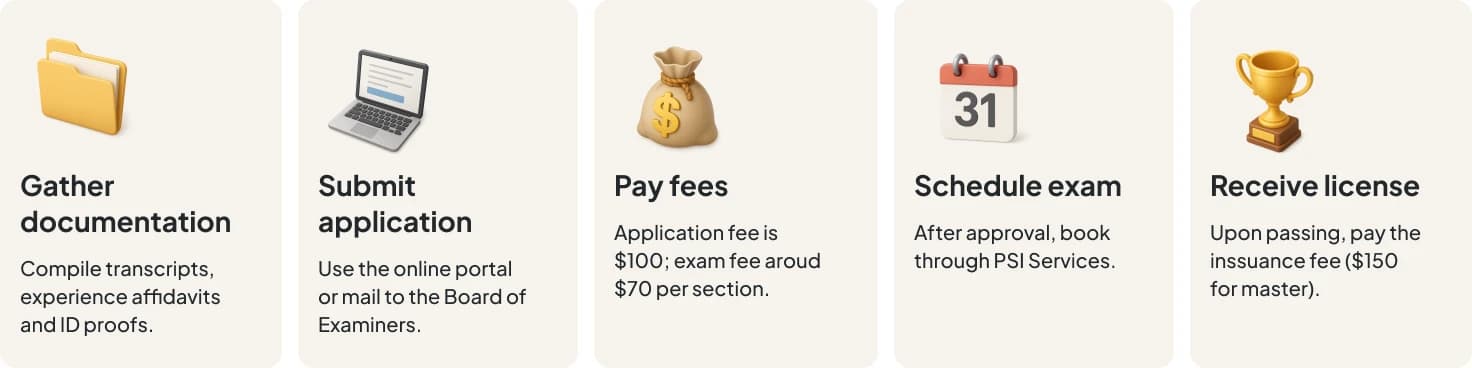
The entire process can take 4-6 months, depending on your readiness. For HVAC license New Jersey online applications, visit the official Division of Consumer Affairs website at njconsumeraffairs.gov/hvacr.
Required documents and fees
Essential documents include:
Completed application form.
Proof of education (diplomas, transcripts).
Experience verification forms signed by employers.
Background check consent.
Two passport-style photos.
Fees vary but total around $300-500 initially. Late renewals incur penalties. Budget for study materials too – books and prep courses cost $200-500.
Fee schedule for New Jersey HVAC licensing
Common pitfalls to avoid
Many applicants falter by submitting incomplete experience logs or underestimating exam prep. Double-check all forms and consider consulting a mentor. If denied, you can appeal within 30 days.

Preparing for and taking the HVAC licensing exam
Exam overview
The New Jersey HVAC exam, managed by PSI, includes:
Exam parts: Business and Law (50 questions) and Trade Knowledge (100 questions).
Topics: NJ codes, electrical systems, piping, and safety.
Journeyman exam: Trade-focused only.
Passing score: 70%.
Format: Open-book – use the International Mechanical Code and NJ Uniform Construction Code
Study trips and resources
Effective preparation is key to how to get a HVAC license in New Jersey swiftly. Dedicate 100-200 hours to studying.
Books: “New Jersey HVACR Contractor License Exam Review” by Ray Holder.
Online courses: Platforms like HVAC School or Udemy offer NJ-specific prep.
Practice tests: PSI provides sample questions; aim for 80% accuracy.
Classes: Local unions or community colleges run boot camps.
Join study groups via Reddit’s r/HVAC or NJ HVAC forums for peer support. Track your progress with flashcards for codes and calculations.
What to expect on exam day
Arrive early at a PSI center (locations in Trenton, Fairfield, etc.) with two IDs. The test is computer-based, 4 hours total. No calculators allowed beyond provided ones. Results are immediate – celebrate if you pass, or retake after 30 days (extra fee).
HVAC license New Jersey online: certification options
Digital pathways to certification
For busy professionals, pursuing an HVAC license New Jersey online is feasible. While the state exam is in-person, much of the prep and application can be virtual. Online vocational programs from schools like Penn Foster or Ashworth College offer flexible HVAC training that counts toward the four-year requirement.
These programs include interactive modules on duct design, troubleshooting, and energy management, often with virtual simulations. Upon completion, you’ll receive transcripts for your application.
Approved online providers
Ensure providers are board-approved. Examples:
HVAC Excellence: Online accreditation for courses.
ESCO Institute: EPA 608 online certification, required alongside state license.
State Portal: Submit apps and track status at njportal.com/DCA/HVACR.
Online apprenticeships via virtual mentorship are emerging, though traditional on-site experience remains essential. For full HVAC license and certification in New Jersey online, combine e-learning with part-time fieldwork.
Pros and cons of online routes
Pros: Flexibility, self-paced, lower costs (tuition $1,000-5,000). Cons: Less hands-on practice; ensure credits transfer to NJ board.
Tip: Verify with the board before enrolling – call 973-504-6405 or email hvacr@dca.lps.state.nj.us.
New Jersey HVAC license renewal and continuing education
Biennial renewal process
New Jersey HVAC licenses expire every two years on odd-numbered years (e.g., 2025). Renew online via the state portal by submitting proof of 7 hours of continuing education (CE) and paying $160. Late renewals add $50 penalties; lapsed licenses require re-exam.
*Biennial: taking place every other year.
Continuing education requirements
CE ensures you stay current with tech like smart thermostats and green refrigerants. Topics must be board-approved, covering code updates, safety, and business practices.
Providers: MCANJ seminars, online via HVACreducation.com.
Hours breakdown: 4 technical, 2 business, 1 ethics.
Tracking: Maintain certificates for audits.
Active licensees get email reminders. For out-of-state work, NJ reciprocity agreements with states like Pennsylvania ease multi-state practice.
How much do HVAC technicians earn in New Jersey?
If you're planning to become a licensed HVAC technician in New Jersey, it's helpful to know what kind of income you can expect. Salaries for HVAC technicians vary based on experience, location, and specialization – but overall, HVAC professionals in NJ earn above the national average.
Experience level | Estimated annual salary | Hourly rate |
|---|---|---|
Entry-level (0-2 yrs) | $37,000 – $50,000 | $18 – $24/hr |
Mid-level (2-yrs) | $55,000 – $75,000 | $26 – $36/hr |
Experienced (5+ yrs) | $70,000 – $100,000+ | $30 – $45/hr+ |
State average | ≈ $65,000/year | ≈ $31/hr |
💡 Pay depends on experience, certifications, and region (higher around North NJ and larger metro areas). Union or commercial work usually pays more. Keep in mind, overtime during peak seasons (summer AC installs, winter heating fixes) can add $5,000–$10,000 annually.
Resources and further reading
Official sources
Rely on these for accurate info:
NJ Board of Examiners of HVACR Contractors – Applications and statutes.
PSI Services – Exam scheduling and prep.
EPA Section 608 – Refrigerant certification.
Mechanical Contractors Association of NJ – Training and networking.
Additional reading
Books: “Modern Refrigeration and Air Conditioning” by Althouse. Websites: HVAC.com for career tips. Join LinkedIn groups for NJ HVAC pros.
For apprenticeships, check apprenticeship.nj.gov.
Conclusion: Your path to HVAC success in New Jersey
Obtaining your HVAC license in New Jersey is a rewarding journey that blends education, experience, and examination into a credential that propels your career forward. From meeting the rigorous New Jersey HVAC license requirements to leveraging online certification options, this guide has outlined a clear roadmap to help you get licensed fast—whether you’re starting out or enhancing your expertise.
As New Jersey pushes toward sustainable building practices and smart energy solutions, licensed HVAC professionals will play a pivotal role in shaping a resilient future. Stay committed to continuous learning, adhere to ethical standards, and tap into the supportive community of tradespeople. With determination, you’ll not only secure your license but also build a thriving career in an industry that’s cooler (and warmer) than ever. Ready to turn up the heat on your ambitions? Start today.
Take your licensed HVAC business further with Workiz
Getting your license is just the beginning – running a successful HVAC business means a lot of daily routine. And here Workiz helps you.
For HVAC professionals, Workiz is the all-in-one field service management (FSM) software built to save you time and grow your business. By streamlining scheduling, dispatching, invoicing, and equipment tracking on one platform, Workiz saves working hours every week. Moreover, with Workiz, HVAC businesses win 25% more jobs through smart sales tools. Integrated features such as Price Book, Workiz Pay, and powerful automations simplify your entire workflow.
Work smarter, grow faster, and deliver five-star service with Workiz – the ultimate FSM platform for HVAC professionals.