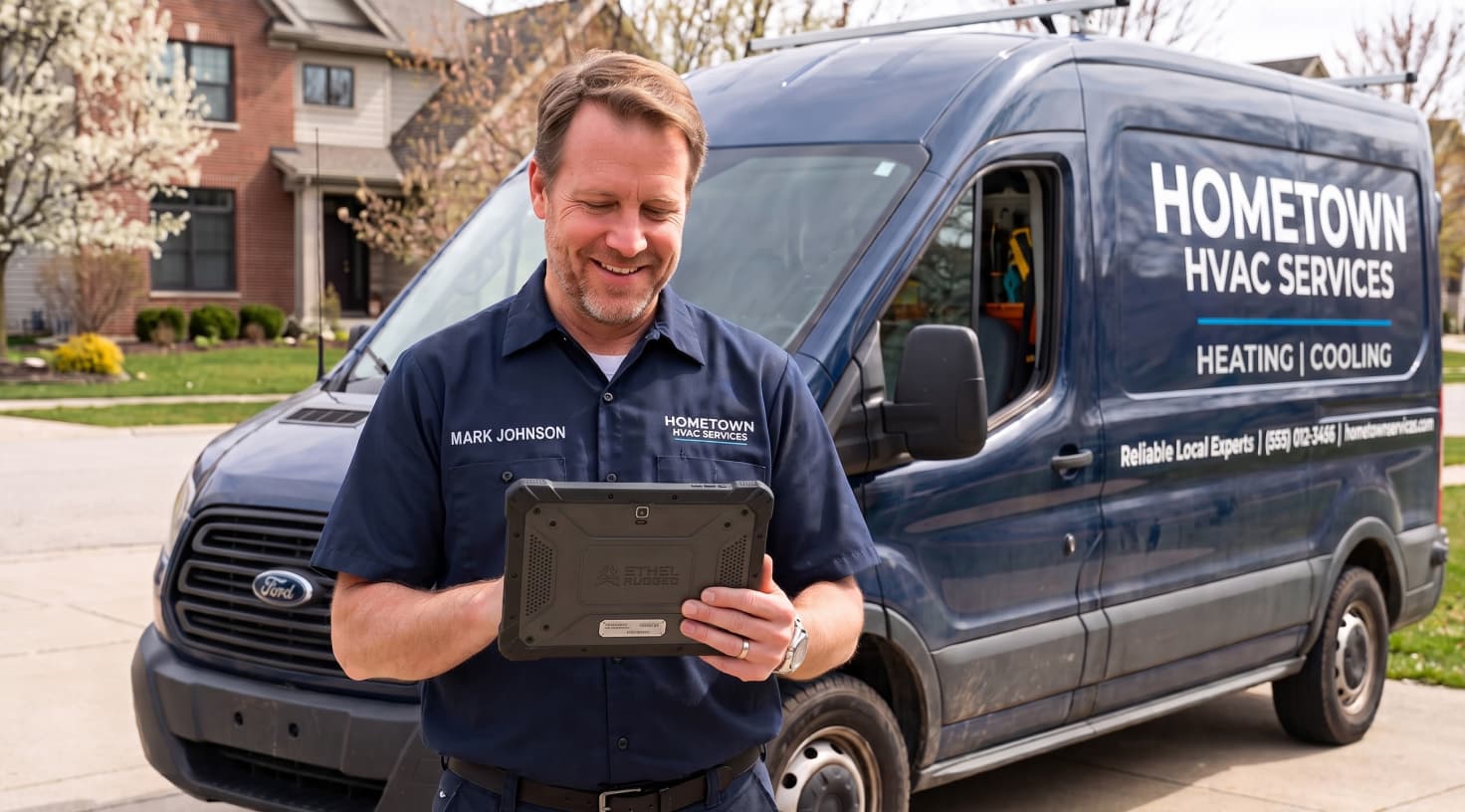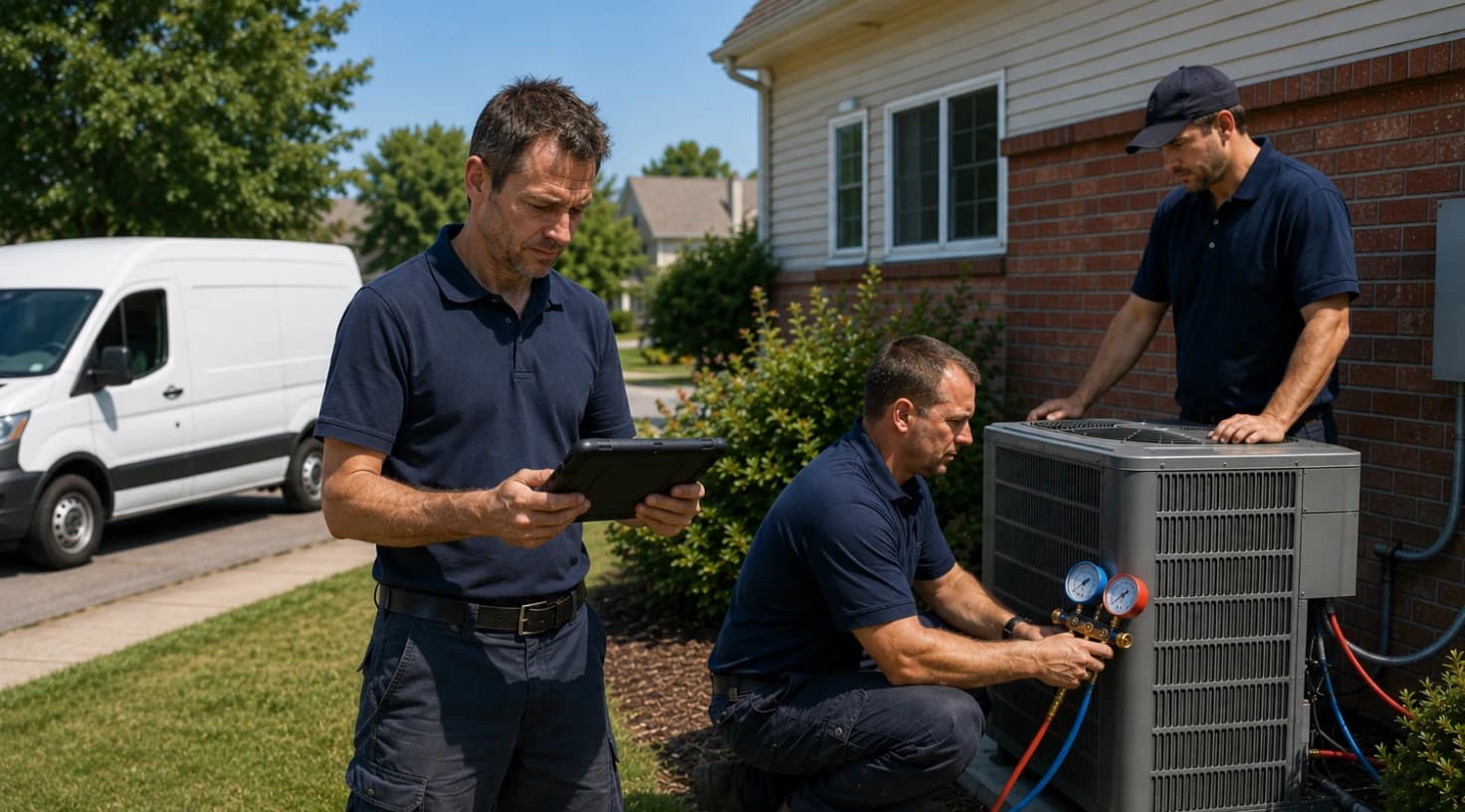

A homeowner calls two technicians from the same HVAC company about a failed capacitor. One quotes $180. The other quotes $260. Same part, same job, same company. She goes with a competitor.
Inconsistent pricing does not just cost you that one job. As your team grows, small gaps in how technicians quote become a steady drain on working capital. Loose field billing habits and unaccounted overhead are quiet but consistent margin killers.
Standardizing your pricing structure ensures every truck on the road delivers predictable profit margins regardless of who is on the call. Here is how to calculate your fully loaded labor rates, eliminate common billing mistakes, and roll out a reliable price book across your entire fleet.
Why Getting HVAC Job Pricing Right Protects Your Business
Setting up clear, calculated job rates shields your profits from sudden parts price hikes and hidden labor costs. Consistent pricing across your fleet makes scaling up simple while keeping every job profitable.
Preserving Profit Margins as Costs Rise
Equipment costs continue to rise due to global tariffs and raw material pressures. When supplier prices climb by 5% to 15% annually, contractors who fail to update their price books absorb these increases directly, shrinking net margins.
Building Customer Trust with Upfront Pricing
Upfront flat-rate pricing stops hourly rate arguments before they start. Giving homeowners a guaranteed total before turning a wrench builds trust, gets estimates approved faster, and eliminates awkward invoice disputes when the job is done.
Keeping Cash Flow Predictable as Volume Grows
The average HVAC contractor operates on thin net margins of 3% to 12%. As your fleet scales, fixed overhead grows. Precise pricing ensures all overhead is recovered on every single job, maintaining positive cash flow.
Factors That Affect HVAC Job Pricing
To build a profitable price book, you must calculate direct and indirect costs. Relying on competitive guesswork leads to underpricing and cash flow leaks.
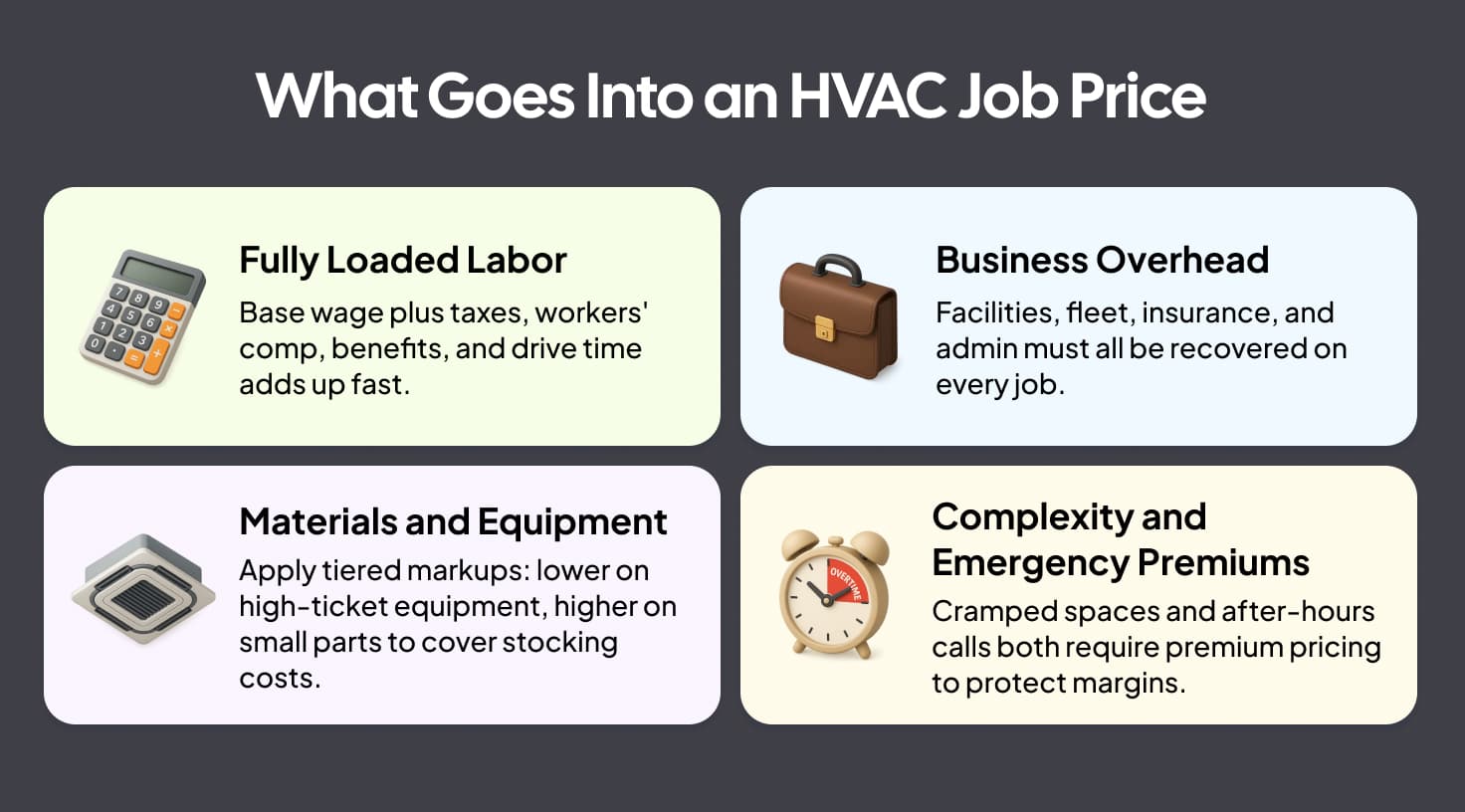
Labor Costs, Including Fully Loaded Rates: Labor represents your largest expense. While the median technician wage was $28.75 per hour in 2024 for reference, your true fully loaded rate must include payroll taxes, workers’ comp, benefits, and drive time. This base wage easily translates into a $90.00 to $220.00 out-of-pocket hourly burden.
Material and Equipment Costs: Material costs range from minor electrical parts to complete condensing systems and ductwork. Maintain gross margins by applying tiered markups: lower markup percentages on high-ticket equipment installations, and higher markup percentages on small parts to cover stocking and inventory handling costs.
Business Overhead: Operating overhead includes facilities, fleet fuel, insurance, software, and administrative salaries. Established companies target an operating overhead ratio of 20% to 30%. Smaller shops often exceed 30% due to fewer billable hours.
HVAC Pricing Models: Which One Fits Your Business
Selecting the right billing model helps manage risk and ensures a professional customer experience. While residential service favors flat rates, commercial work often requires time-and-materials structures.
Pricing Model | Mechanics & Cost Structure | Ideal Use Case | Margin Impact & Risk |
Flat-Rate Pricing | Combines labor, loaded labor rates, marked-up materials, and overhead. | Routine residential repairs. | Highly profitable; rewards speed, but business bears risk if jobs run long. |
Time-and-Materials Pricing | Bills exact hours worked, plus marked-up materials. | Commercial service and custom retrofits. | Predictable margins, but caps growth and penalizes fast technicians. |
Hybrid Pricing | Charges flat-rate for diagnostic and standard tasks, and hourly rates for custom work. | Complex residential renovations. | Balances risk on complex projects, securing margins on variable jobs. |
Maintenance Plan & Membership Pricing | Discounted flat-rate visits billed recurring monthly or annually. | Residential preventive maintenance programs. | Drives predictable, recurring revenue to keep techs busy during slow shoulder months. |
How to Price HVAC Jobs Step by Step
Different HVAC jobs need different pricing strategies. Homeowners usually want a clear flat rate upfront, but larger commercial calls often call for time-and-materials billing to cover complex labor and parts.
Calculate Fully Loaded Labor Costs
Add technician wages to taxes, workers’ comp, benefits, and vehicle allocations. Divide this annual cost by actual billable hours (usually maxing out at 1,500 per tech) to determine your loaded hourly rate.
Add Materials, Equipment, and Overhead
Calculate your hourly overhead recovery rate by dividing annual overhead by total billable tech hours. For each task, combine the estimated labor hours, material cost, and overhead to establish your base cost floor.
Organize Into a Standardized Price Book by Job Type
Import your calculated flat rates into a searchable digital price book. Ensure every entry includes a task code, clear service scope, and a margin floor to prevent unauthorized field discounting.
Set Markup Using the Margin Divisor Formula
Do not confuse markup with net profit margin. Markup adds a percentage directly to your cost, while profit margin is the percentage of the final selling price that remains as profit. Use the margin divisor formula, supported by the U.S. Bureau of Labor Statistics wage cost data and standard accounting practices, to calculate a true target net profit margin.
If a standard motor repair costs $150 and you target a 30% margin, dividing $150 by 0.70 yields a selling price of $214.29. A simple 30% markup results in $195, reducing your actual margin to 23%.
Common HVAC Pricing Mistakes
Standardizing your pricing requires continuous reviews and operational discipline. Eliminating standard math errors in the office prevents margin leaks in the field.
Common Pricing Mistake | Real-World Impact | Corrective Action |
Leaving Overhead Out of the Calculation | Rent, insurance, and dispatcher salaries are left unpaid. | Divide annual indirect overhead by billable hours to build overhead recovery into every task. |
Confusing Markup With Profit Margin | Applying a simple markup directly to your cost floor leads to lower net profits than planned. | Calculate final retail rates using the standard margin divisor formula: Price is equal to total cost divided by one minus target margin. |
Using Outdated Material Prices | Unplanned supplier price increases silently erase gross profit margins on replacements. | Use a digital price book to push real-time material price updates directly to the field. |
Underpricing Emergency and After-Hours Work | Paying technicians premium overtime rates while billing standard daytime flat rates. | Implement a clear after-hours multiplier (1.5x to 2x) or a dedicated emergency service fee. |
Presenting HVAC Pricing in the Field
An accurate pricing system is only effective if presented correctly. Technicians must be trained to present these rates confidently and transparently right from the driveway.
Using Good/Better/Best Proposals to Increase Ticket Size
Instead of forcing a single “yes-or-no” price, present three tiered options:
This multi-option strategy removes high-pressure sales tactics and empowers homeowners to select the option that best fits their budget.
Offering Financing to Close System Replacements on the Spot
Sudden equipment replacements strain residential budgets. Integrating consumer financing directly into mobile estimates allows homeowners to get approved instantly on-site. Offering pay-over-time plans on major installs boosts close rates and raises average ticket sizes.
HVAC Pricing Best Practices
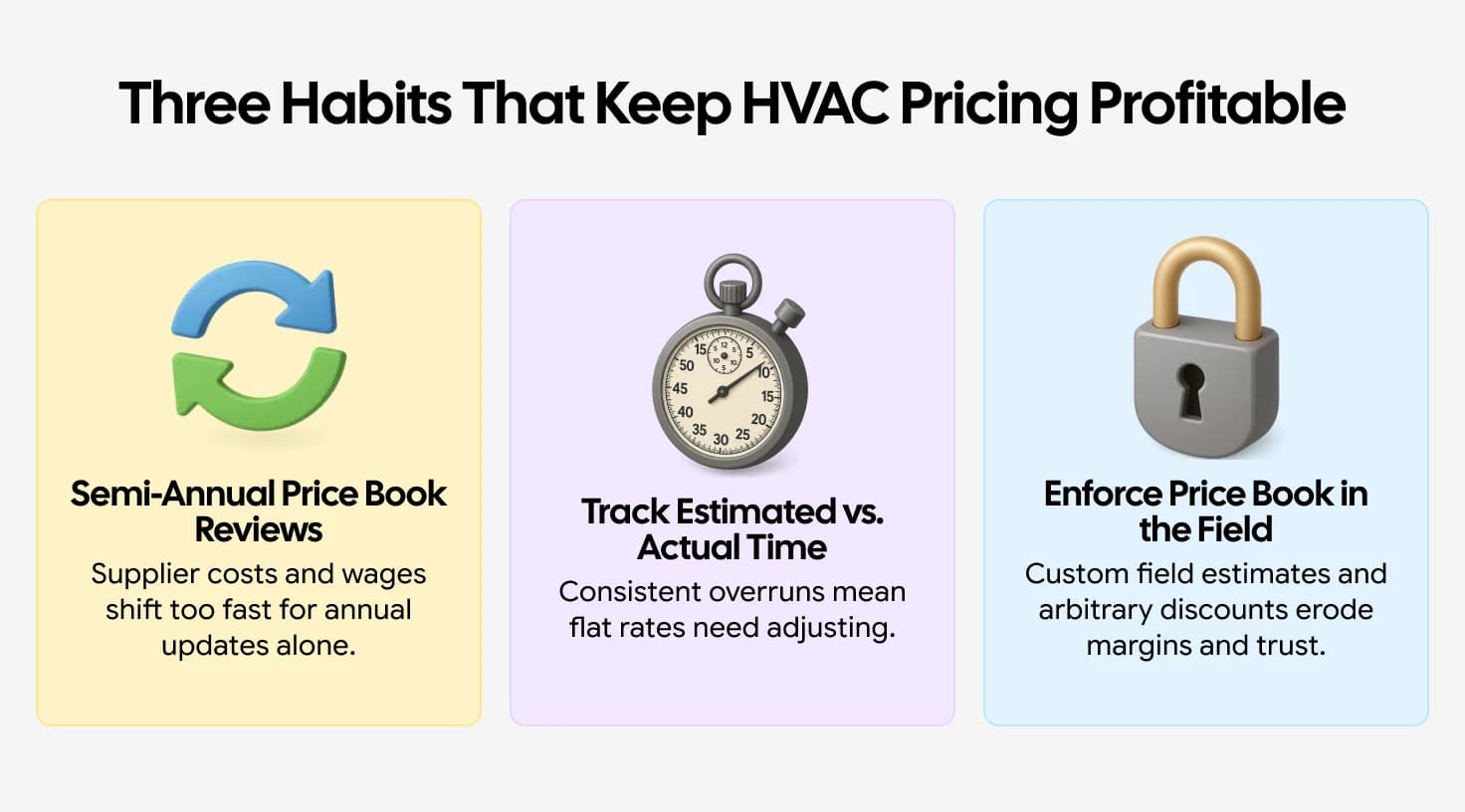
Sustaining high profitability as your operation scales requires strict field standards and regular price book reviews. Implement these three core operational habits to safeguard your cash flow:
Review Costs and Update the Price Book Semi-Annually: Supplier costs, fuel rates, and labor wages change too rapidly for annual guesswork. Semi-annual reviews prevent unexpected pricing spikes from eroding your profit margins.
Track Actual Job Time Against Estimated Time: Compare real-time on-site wrench time against your price book’s labor hour allocations. If jobs consistently take longer than estimated, adjust your flat rates to cover the unapplied labor costs.
How Workiz Helps HVAC Businesses Price Jobs More Profitably
Managing flat rates manually becomes impossible when scaling a fleet of 5 to 50 technicians. Workiz provides an all-in-one platform built to standardize pricing and secure your profit margins.
Build and Send Estimates From the Mobile App on the Job: Right from the driveway, technicians can access the digital price book, find fixed service codes, and build accurate flat-rate estimates on their phones, eliminating math errors and administrative phone loops.
Good/Better/Best Proposals That Increase Average Ticket Size: With the digital price book, technicians can present clear, professional tiered proposals directly on a tablet. Presenting good/better/best choices gives customers full clarity over their options and helps your team close higher-value installation jobs.
Collect Payment on Site With Workiz Pay: Accept credit cards, mobile payments, or consumer financing approvals on-site via Workiz Pay. This accelerates cash flow and eliminates invoicing delays.
QuickBooks Sync Keeps Pricing and Job Costs Aligned: Invoices and payments automatically sync to QuickBooks, removing double-entry errors and giving owner-operators real-time visibility into job margins.
Conclusion
Inconsistent job estimates quietly drain working capital, no matter how many calls your team completes each week. Transitioning to a calculated flat-rate price book ensures every technician quotes accurately and guards your bottom line on every job.
An all-in-one field service management platform like Workiz puts exact rates directly into your techs’ mobile app, helping field pros win up to 3x more jobs and drive predictable revenue growth.