Understanding PPC fundamentals for garage door businesses
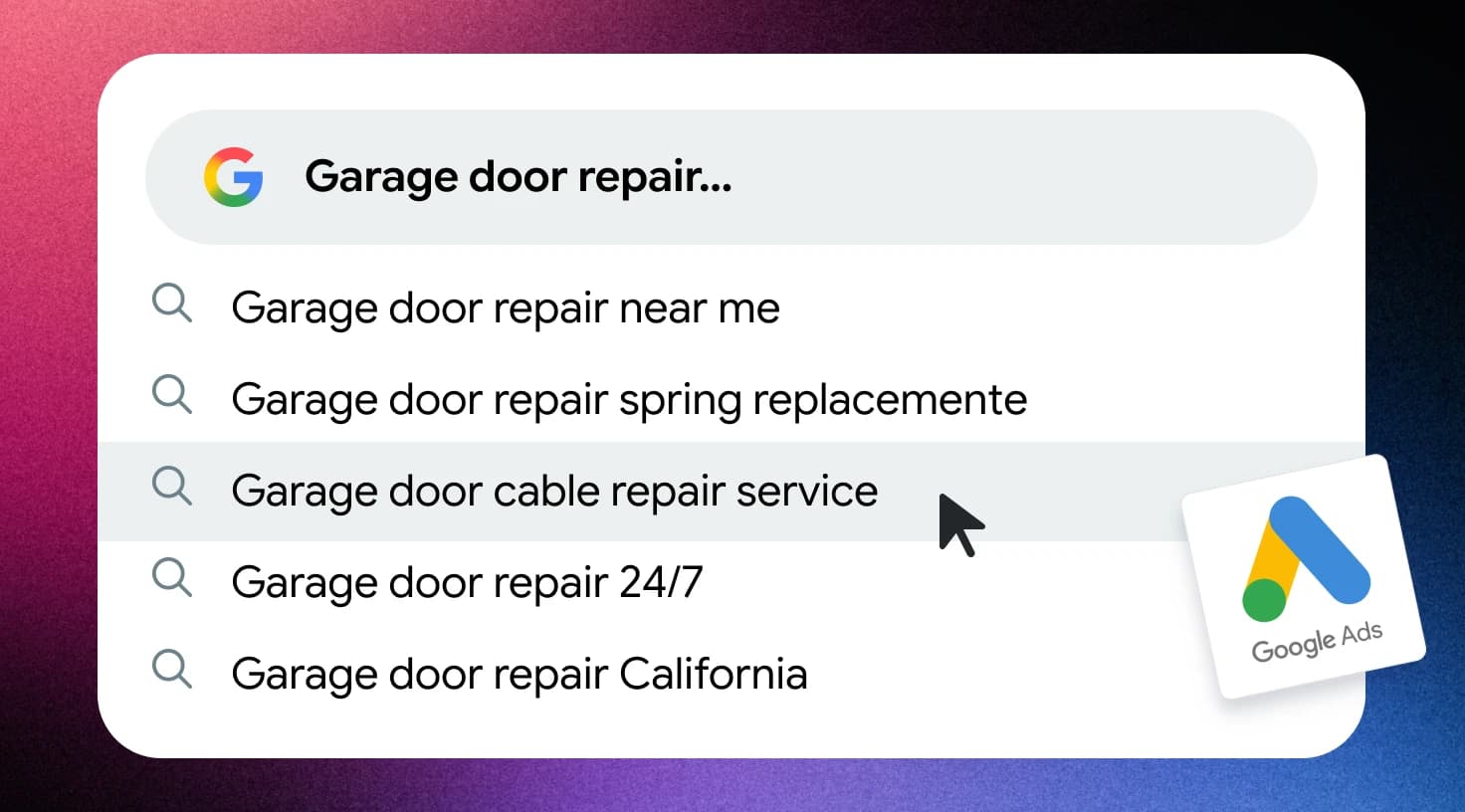
Pay-per-click advertising, particularly through platforms like Google Ads, allows garage door companies to bid on keywords and pay only when users click your ads. For garage door repair PPC, this model is ideal because it targets intent-driven searches—people actively looking for “garage door repair near me” are often in crisis mode and ready to convert.
Why PPC outshines organic SEO for urgent services
Unlike search engine optimization (SEO), which takes months to yield results, PPC delivers instant visibility. In the garage door industry, where 70% of searches are local and time-sensitive, garage door PPC campaigns can capture leads that organic traffic might miss. According to Google, home services ads see an average 2x higher conversion rate than other industries when optimized properly.
Key benefits include:
Geographic precision: Target specific zip codes or radii around your service area.
Budget control: Set daily limits to avoid overspending.
Measurable ROI: Track every click, call, and form submission.
Seasonal flexibility: Ramp up during storm seasons when door damage spikes.
Best PPC platforms for garage door advertising
To dominate the garage door market across the US, your strategy should leverage these core platforms:
For further reading, check Google’s official guide on PPC Basics.

Keyword research: The foundation of effective garage door PPC
Success in garage door repair PPC hinges on selecting the right keywords. Focus on high-intent terms like “emergency garage door repair” or “broken garage door spring fix,” which signal immediate need. Tools like Google Keyword Planner are essential—aim for keywords with 100-1,000 monthly searches and competition scores under 0.5 for better ROI.
Match types and negative keywords
Use exact and phrase match types to control relevance. For instance, [garage door repair] ensures your ad shows only for that precise query. Add negatives like “DIY” or “free” to filter out low-value traffic, reducing wasted spend by up to 25%.
Here’s a sample keyword table for garage door PPC campaigns:
Keyword type | Example keywords | Est. monthly searches | Avg. CPC |
|---|---|---|---|
High-intent repair | “garage door repair your city” | 500-1,000 | $5-10 |
Installation focus | “new garage door installation cost” | 200-500 | $8-15 |
Long-tail | “fix garage door opener not working” | 100-300 | $3-7 |
Integrate these into your garage door advertising strategy to balance volume and relevance.
The single keyword ad group (SKAG) method: A game-changer for garage door PPC
The SKAG approach revolutionizes garage door PPC campaigns by dedicating an entire ad group to a single keyword. This hyper-focused structure allows for tailored ads and bidding, leading to Quality Scores of 9/10 or higher, which slashes CPCs by 20-50%. In my experience with PPC for garage door companies, SKAGs have consistently delivered 40% conversion rates when paired with location-specific landing pages.
How to implement SKAGs step-by-step
Select core keywords: Choose 5-10 high-value terms like [garage door repair] or [emergency garage door service].
Create isolated ad groups: Build one ad group per keyword, avoiding broad themes.
Customize ads: Write ad copy that mirrors the keyword exactly—e.g., “Need Garage Door Repair? Fast Service in your city!”
Link to dedicated pages: Direct to landing pages optimized for that keyword, featuring testimonials, service details, and clear calls-to-action (CTAs).
Monitor and adjust: Use A/B testing on headlines and extensions; pause underperformers weekly.
SKAGs excel in garage door online advertising because they minimize ad irrelevance, boosting click-through rates (CTRs) to 10-15%.
Hyper-local ad copy: Inserting city names for relevance
📌 Pro tip Test city-specific variants like “garage door repair Dallas TX” to capture regional nuances, potentially lifting local CTRs by 30%.
.
Landing pages: Driving 40% conversion rates in garage door ads
Your landing page is the make-or-break point after a click. For garage door repair PPC, create dedicated pages per service and location—e.g., /repair-austin vs. /install-dallas. These should load in under 3 seconds, be mobile-optimized, and include trust signals like Google reviews and certifications.
Key elements of high-converting landing pages
Using tools like Google Optimize for A/B testing, I’ve achieved 40% conversion rates by focusing on user pain points, such as “24/7 Emergency Garage Door Repair.”
For best practices, refer to Google’s Landing page guidelines.
Contrasting strategies: Repair vs. installation in garage door PPC
Garage door services split into two buckets: repairs (urgent, high-conversion) and installations (considered, higher-value). Tailor your garage door PPC campaigns accordingly to maximize ROI.
Strategic factor | Repair campaigns | Installation campaigns |
|---|---|---|
User mindset | Panic / Immediate solution | Planning / Aesthetic upgrade |
Ad extensions | Call & Location extensions | Sitelink & Image extensions |
Landing page tool | Click-to-call button | Design gallery / ROI calculator |
Remarketing role | Low (Immediate conversion) | Critical for 30-day cycle |
Primary metric | Cost per lead (CPL) | Return on ad spend (ROAS) |
Repair campaigns: Urgency and low-barrier hooks
Repairs drive quick wins. Target keywords like “garage door won’t open” with hooks such as “$29 Service Calls” to lower entry barriers. Ads emphasizing “Same-Day Repair – No Hidden Fees!” convert at 35-45%, with CPLs around $50. Use call extensions for immediate bookings, as 80% of repair leads come via phone.
Price guarantees like “100% Satisfaction or Free Redo” build trust, closing 1-in-3 leads into jobs averaging $300-500.
Installation campaigns: Education and value proposition
Installations involve longer decision cycles. Bid on “garage door installation cost your city” with ads highlighting “Free Quotes – Energy-Efficient Doors from $1,200.” Focus on remarketing to nurture leads, using display ads to showcase warranties and financing options. To further build authority, provide leads with resources like a guide to the top garage door manufacturers of 2026 to help them make an informed purchase. Expect CPLs of $70-90 but lifetime value up to $2,000 per customer.
Contrast: Repairs prioritize speed; installations emphasize quality and ROI calculators on landing pages.

Budgeting and bidding best practices for garage door paid advertising
Start with a $50-100 daily budget per campaign, scaling based on performance. For Google Ads garage door setups, use automated bidding like Target CPA to hit $50-90 CPL targets. Manual CPC works for SKAGs, starting at 20% below estimated costs.
ROI calculation and scaling tips
Track metrics: Aim for 5:1 ROAS (return on ad spend). If a $60 CPL lead closes at 33% (1-in-3 rate) for a $400 job, your effective cost is $180—highly profitable.
Seasonal adjustments: Increase budgets 50% during winter for weather-related repairs.
Geo-bidding: Boost bids 20% in high-demand areas.
Performance thresholds: Pause keywords with CTR under 5% or conv rate below 20%.
A sample budget table:
Campaign type | Daily budget | Target CPL | Expected leads/Mo |
|---|---|---|---|
Repair SKAGs | $75 | $50 | 45 |
Installation | $50 | $80 | 20 |
Remarketing | $25 | $40 | 15 |
Scaling success: Bing, YouTube, and Demand Gen for garage door PPC
Once Google Ads garage door campaigns stabilize, diversify. Bing Ads offers similar setups but lower competition, yielding 25% better CPLs for garage door advertising.
Targeting DIYers with YouTube and Demand Gen
Many searches start with DIY attempts. Use YouTube ads for short videos like “How to Fix a Garage Door Spring (or Call Pros!)” to intercept at the top of the funnel. Demand Gen campaigns on Google target users on sites like Home Depot, driving awareness and remarketing traffic.
Strategy: Allocate 20% of budget here. Video views cost $0.10-0.20, converting 10-15% of viewers to site visits. For DIYers, hooks like “Stuck? Get Pro Help for $29” bridge to service calls.
Link to Microsoft’s Bing Ads Overview for setup guidance.
Leveraging Workiz for garage door service efficiency
As your garage door PPC campaigns generate a flood of leads, efficient management becomes crucial. Workiz is a powerful all-in-one software platform designed specifically for field service professionals like garage door repair companies. It streamlines operations from lead intake to invoicing, ensuring no opportunity slips through the cracks.
With Workiz, you can integrate call tracking and form submissions directly into your CRM, automate scheduling for same-day repairs, and provide real-time updates to customers via the mobile app. This not only boosts your 1-in-3 closing rate by enabling faster response times but also enhances customer satisfaction with features like GPS dispatching and digital payments.
For garage door businesses scaling PPC efforts, Workiz turns leads into revenue seamlessly—freeing you to focus on growth rather than admin hassles. Scale your advertising efforts with confidence by optimizing your garage door service operations to ensure no high-value lead ever slips through the cracks.
Avoiding pitfalls and continuous optimization
Common mistakes in garage door PPC include ignoring mobile optimization (50% of clicks) or neglecting ad extensions like location and callouts. Regularly audit for ad fatigue—refresh copy every 30 days.
Advanced tactics for long-term success
Audience layering: Add in-market segments for “home improvement” to refine targeting.
Conversion tracking: Set up Google Analytics for micro-conversions like quote requests.
Competitor analysis: Use tools like SEMrush to spy on bids without endorsing rivals.
Benchmarks to beat: Maintain $50-90 CPL and 1-in-3 closes through quarterly reviews.
Conclusion: Building a thriving garage door business with PPC
Garage door repair PPC campaigns offer a proven path to high-ROI growth, from SKAG precision and hyper-local ads to strategic scaling across platforms. By contrasting repair urgency with installation value, incorporating hooks like $29 service calls, and aiming for 40% conversions, you can achieve $50-90 CPLs and close 1-in-3 leads effectively.
As digital advertising evolves, staying agile—testing new formats like video and embracing tools like Workiz—will keep your edge. Implement these strategies, monitor relentlessly, and watch your garage door company dominate local searches. The future of garage door advertising is targeted, measurable, and immensely profitable—start your campaign today!