
Understanding Georgia general contractor license requirements
Before you submit your application, you must understand the criteria set by the Georgia State Licensing Board for Residential and General Contractors (GSLRGC). Specifically, these standards ensure that firms with multiple employees operate safely and professionally. The board oversees both residential and commercial licenses. Consequently, each type has distinct criteria that impact how you manage your crew and projects.
Basic eligibility criteria for construction firms
To qualify for a general contractor license in GA, your designated agent must meet several core prerequisites. These rules protect consumers and maintain high industry standards for growing businesses.
Age and legal standing: Applicants must be at least 21 years old. Additionally, you need a valid Georgia business address to register your entity legally.
Management experience: You must demonstrate at least two years of verifiable experience in construction supervision. Specifically, this includes roles like foreman or project manager where you led a team. You will need to submit signed affidavits to prove this oversight.
Financial stability: You must provide proof of your company's financial health. Typically, this includes a credit report or a financial statement showing a solid net worth. Furthermore, a surety bond of $25,000 is usually required for general contractors.
Insurance for teams: You must secure general liability insurance with a minimum of $500,000 aggregate coverage. Moreover, workers' compensation is mandatory since your business employs three or more people.
Clean background: The state requires a background check for all applicants. Consequently, any felony convictions related to fraud or construction may disqualify your firm.
For residential contractors, the focus remains on home-building projects under $100,000. However, general contractors handle larger commercial and unlimited residential work. You should always verify updates on the official Georgia Secretary of State – Residential and General Contractors website to stay compliant.
Differences between residential and general contractor licenses
Georgia offers different license tiers based on the scope of your business operations. Specifically, choosing the right one is vital for a team of three or more.
Aspect | Residential Contractor License | General Contractor License |
|---|---|---|
Project Scope | Single-family homes and renovations under $100,000 | Commercial buildings, multi-family, and unlimited residential |
Experience Required | 2 years in residential construction | 2+ years in general construction management |
Exam | Residential-focused sections | Broader general contracting exam |
Bond Amount | $15,000 minimum | $25,000 minimum |
Overall, a residential license might suffice if you're starting small. However, many firms with 3+ employees aim for the general contractor license GA for broader opportunities.

Preparing your business before applying
Securing a contractor license GA isn't just about personal qualifications. Specifically, your business structure must be in place before you start the process. This preparation streamlines the application and sets a solid foundation for your operations. Consequently, having a clear legal structure protects you and your entire team.
Registering your business entity
Georgia requires contractors to operate as a legal entity. Specifically, your options include a sole proprietorship, LLC, or corporation. For most teams of three or more, forming an LLC offers the best liability protection.
Once you are registered, your business name must include "Contractor" or a similar term to reflect your trade. Overall, completing these steps early prevents delays during the board's review.
Securing bonds and insurance
Insurance and bonding are non-negotiable for licensure in Georgia. Specifically, general liability covers property damage or injuries on the job site. Meanwhile, a surety bond protects your clients against non-performance or contractual issues.
Get quotes: Contact insurers like The Hartford or Travelers to compare rates. Typically, these rates vary based on your experience and the size of your crew.
Obtain bonds: You can secure bonds through specialized surety companies. Expect annual premiums to range between 1-3% of the total bond amount.
Maintain compliance: Keep all your certificates current at all times. The board reviews these documents carefully during the approval process.
The step-by-step application process
Applying for your general contractor license in GA involves a structured process through the GSLRGC. Specifically, you should expect 4-6 months for approval, so start the process early. All forms are available online. Consequently, following these steps precisely will help your business avoid unnecessary delays.
Step 1: Gather required documentation
Compile these essentials before you begin:
Application form: Download the latest version from the official GSLRGC Licensing Board website. Specifically, look for the "Application/Form Downloads" section to find the current forms for your team.
Proof of experience: Provide W-2s, contracts, or three reference letters from licensed contractors. Specifically, ensure these documents highlight your management of construction projects.
Financial statements: Submit a financial statement audited by a CPA if your company's net worth exceeds $50,000. This is typical for growing firms with multiple employees.
Certificates: Include your current insurance and bond certificates.
Fees: Attach a passport-style photo and the $200 non-refundable application fee.
Step 2: Submit your application
Mail or submit your package online to the GSLRGC at:
2 Martin Luther King Jr. Drive SE, Suite 356, Atlanta, GA 30334.
Additionally, include a cover letter that outlines your professional experience. The board reviews applications for completeness within 30 days. Overall, if the board approves your application, you will receive an authorization letter to take the exam. You can track your status via the board's online portal.
Step 3: Designate a qualifying agent
For general licenses, you must designate a "qualifying agent" to represent your firm. Specifically, this person acts as the primary link between your business and the licensing board.
Step 4: Background check and final approval
The board conducts a criminal background check via fingerprints (GCIC/NCIC). Typically, these fees range from $50 to $75. Upon passing the final review, the state issues your license. Overall, this license remains valid for two years and authorizes your team to handle unlimited residential or commercial projects.

Mastering the exam: A strategic guide for your business
The licensing exam is a pivotal hurdle in your journey toward a Georgia general contractor license. Specifically, PSI Services administers this computer-based test to ensure you master both technical and business knowledge. For a firm with a growing team, passing this exam validates that your leadership can effectively manage safety, payroll laws, and legal risks.
Exam structure and content
The general contractor exam consists of two distinct parts: the National (business and law) and the Georgia-specific sections. Specifically, you must pass both to qualify for the license.
National portion (80 questions, 3.5 hours): This section covers contracts, project management, safety, and estimating. Typically, you need a passing score of 70% to succeed.
Georgia portion (50 questions, 2 hours): This part focuses on state laws, licensing rules, and lien procedures. Furthermore, it covers OSHA standards and Georgia's Uniform Commercial Code.
Overall, the exam has a no open-book policy. Consequently, your designated agent must study thoroughly to ensure your business operations remain uninterrupted by a failed attempt.
Section | Number of Questions | Time Allowed | Key Topics |
|---|---|---|---|
National | 80 | 3.5 hours | Business finance, safety codes, estimating |
Georgia | 50 | 2 hours | State regulations, worker protections |
Professional preparation for busy owners
Success rates typically hover around 60-70%, so strategic preparation is vital for your company's timeline. Specifically, a failed exam can delay your team's ability to bid on large projects for months.
Review the official materials: Start with the PSI Candidate Information Bulletin to understand the latest 2026 testing protocols.
Delegate to study: For owners of teams with 3+ people, the biggest challenge is time. Specifically, delegate daily operations to your foreman for 1-2 weeks to focus on prep courses from providers like Contractor Campus.
Focus on liability: Practice with sample questions, specifically focusing on worker protections and insurance requirements. Moreover, ensure your agent understands the 2026 building code updates to protect your firm from future litigation.
Scheduling: Book your exam via PSI Testing Centers. Typically, fees are $100 per section.
Retake policy: If your agent fails, they must wait 30 days before a retake. Additionally, the state allows only three attempts per year. Consequently, a systematic approach is much more cost-effective than rushing into the test unprepared.
Investment guide and operational costs
Budgeting for the general contractor license GA process is vital for your company's financial stability. Specifically, for a firm with at least three employees, total initial costs typically range from $3,500 to $7,500. This estimate includes mandatory insurance and professional services that are higher for teams than for individual contractors.
Breakdown of investment
State Licensing Fees | Cost & Details | Business Protection | Cost & Details |
Application Fee | $200 (Non-refundable) | Surety Bond | $250 – $1,000 (1–3% of total) |
Initial License Fee | $150 (Paid upon approval) | Liability Insurance | $1,500 – $3,000 (For $500k+) |
PSI Exam Fees | $200 (Total for both parts) | Workers' Comp | Varies (Mandatory for 3+) |
Background Check | $50 – $75 (Fingerprinting) | CPA Audit/Report | $500 – $1,500 (If net >$50k) |
Strategic financial planning for your firm
Beyond the official state fees, a growing business must account for operational costs during the 4-6 month waiting period. Specifically, you should budget for services that ensure your long-term legal protection and compliance.
CPA certification: An audited financial statement is often required for general licenses. Typically, hiring a CPA to certify your firm's net worth ensures your application isn't rejected for technical errors.
Workers' Compensation: Because you have a team, Georgia law requires this coverage. Consequently, skipping this step can lead to massive fines and potential license revocation.
Payroll and administrative costs: Ensure you factor in employer-side taxes and the cost of managing your employees' documentation. Maintaining a clean financial record makes your biennial license renewal much smoother.
Managing your contracting business efficiently
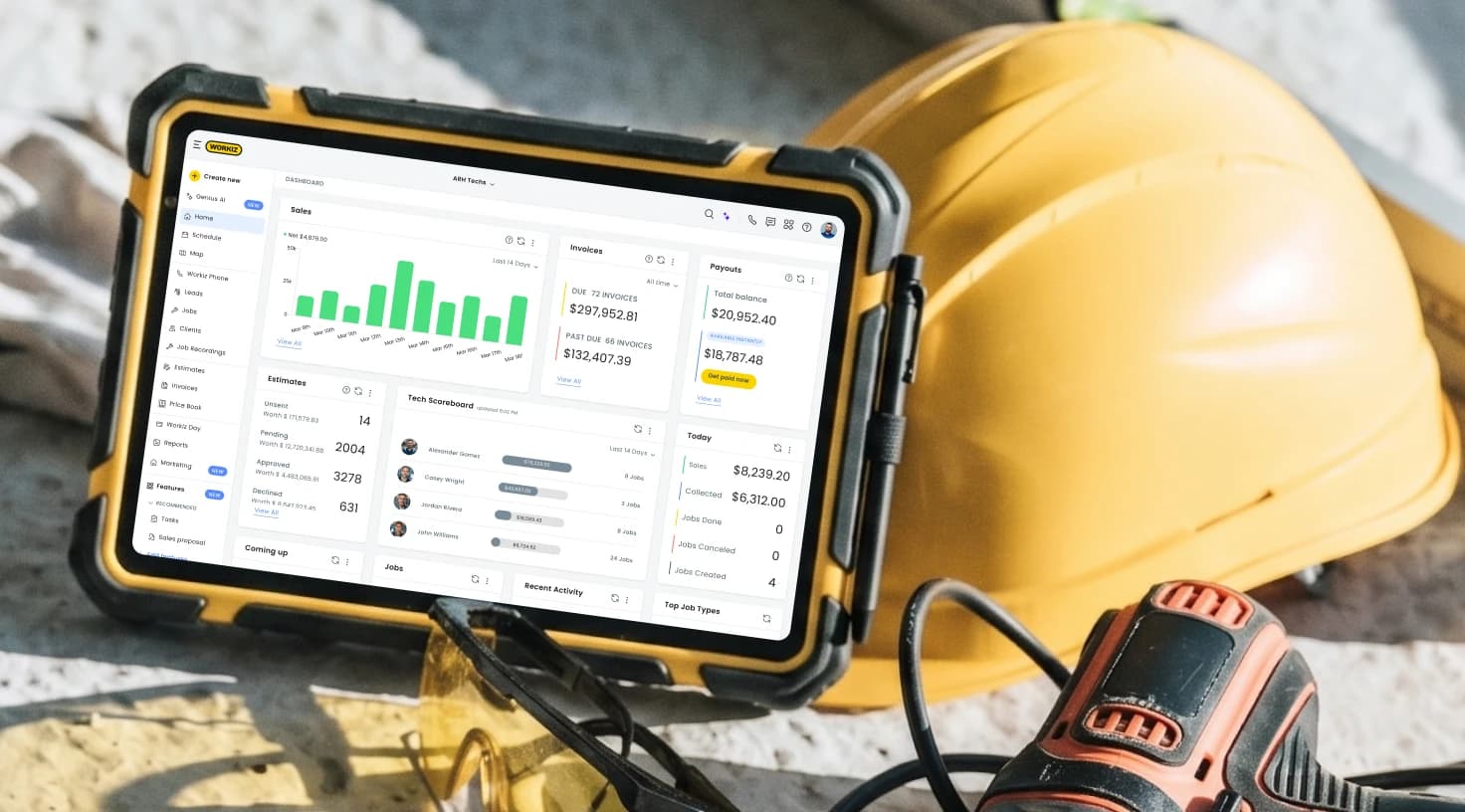
Once licensed, streamlining operations is vital for sustainable growth. Specifically, field service software can transform how you handle scheduling, invoicing, and client communication in Georgia's competitive market.
Leveraging Workiz for general contractors
Managing projects from bids to completion can be overwhelming for a newly licensed general contractor. Specifically, Workiz is an all-in-one field service management software designed to automate workflows and boost your team's productivity.
Many Georgia contractors report saving up to 20 hours weekly with customizable dashboards. Overall, using professional tools allows you to focus on scaling your business rather than managing paperwork.
Common licensing mistakes to avoid
Navigating how to get a general contractor license in GA can be complex for a growing firm. Many applicants face long delays due to simple oversights. Specifically, learning from common errors will help your business expedite the approval process and avoid unnecessary costs.
Incomplete documentation: Double-check your management experience proofs. Specifically, vague reference letters that don't detail your 3+ person project oversight often lead to rejections.
Underestimating exam preparation: For busy owners, lack of focus is the biggest risk. Rather than rushing, delegate operations and dedicate consistent study time to ensure your qualifying agent passes on the first try.
Ignoring insurance lapses: Your liability and Workers' Comp policies must remain active throughout the entire application period. Specifically, even a small gap can void your submission and force your team to start over.
Missing critical deadlines: Exam authorizations typically expire after 90 days. Consequently, you must schedule your test promptly to avoid losing your application fee.
Overlooking local permits: While state-licensed, counties like Fulton or Gwinnett often require additional local registrations. Overall, ensure you check local municipal codes before your crew starts work on-site.
Consult the GSLRGC Licensing Board website for official guidance and FAQ sections. While hiring a licensing service can help, always verify their credentials to protect your company from scams.
License renewal and ongoing maintenance
Your general contractor license GA remains valid for two years. Specifically, consistent renewal ensures continued compliance and uninterrupted access to high-value projects for your team.
Renewal process
Late renewals incur a $50 penalty. Furthermore, lapsed licenses often require a full reapplication, which can take months. Consequently, you should stay informed via board newsletters regarding the latest 2026 code changes to remain competitive.
Maintaining compliance
Post-licensure, your firm must adhere to strict operational rules. Specifically, for businesses with employees, you must ensure prompt payments to subcontractors and maintain proper signage on all job sites. Violations can lead to fines up to $1,000 or even license suspension.
Overall, using professional tools like Workiz to log all site activities makes audits much easier. By maintaining detailed records of your team's work, you protect your business reputation and ensure long-term success in the Georgia market.

Conclusion and your path to success in Georgia
Obtaining your general contractor license in Georgia for 2026 is a strategic investment in your firm's future. From meeting eligibility requirements and preparing documentation to mastering the exam and leveraging business tools like Workiz, this guide equips you with the knowledge for a smooth journey. Remember, the process demands patience and precision. Specifically, the rewards of legal authority, larger projects, and professional credibility for your entire crew are immense.
As Georgia's construction landscape evolves with sustainable building initiatives and tech integrations, staying proactive will set your business apart. Specifically, you should consult official resources regularly, avoid common administrative errors, and focus on building a compliant, efficient operation. With your license in hand, you're ready to scale your team and contribute to the state's growth while achieving your entrepreneurial goals. Start today because your licensed future awaits.
For the latest updates, visit the Georgia Secretary of State's website or contact the GSLRGC at (404) 424-9966.