Understanding electrician licenses in Mississippi
The Mississippi State Board of Contractors (MSBOC) oversees electrician licensing across the state. This board specifically regulates contractor licenses, including those required for professional electrical work. Unlike states with a single centralized system, Mississippi often requires journeymen and masters to hold a contractor's license to operate independently or supervise large projects. Consequently, local jurisdictions like Jackson or Harrison County may impose their own specific registration requirements for hands-on tasks.
Types of electrician licenses
The two primary levels of licensure for electricians in Mississippi are the journeyman and master electrician licenses. These designations reflect varying degrees of experience, skill, and responsibility.
Understanding these distinctions is key to determining which Mississippi electrician license path suits your career goals. For instance, if you're aiming to start your own firm, pursuing the master electrician license Mississippi requirements early can set you on a faster track to entrepreneurship.
Why licensing matters
Licensing ensures that every project meets the standards set by the National Electrical Code (NEC). These regulations protect public safety by preventing hazards like fires and electrical shocks. In Mississippi, unlicensed work carries heavy risks. Violations can lead to fines of up to $1,000, immediate project shutdowns, or even criminal charges. Conversely, a valid license boosts your credibility and provides access to high-paying jobs in the residential, commercial, and industrial sectors.
Comparison: journeyman vs. master electrician licenses
Aspect | Journeyman | Master |
Experience Required | 4-8 years apprenticeship | 2 years as journeyman + 7-10 years total |
Scope of Work | Installation and repair under supervision | Design, supervision, and contracting |
Exam Focus | Practical NEC knowledge | Advanced planning and business law |
Annual Renewal Fee | $50 – $100 | $100 – $200 |
While both licenses demonstrate professional competence, choosing the right one depends on whether you aim to work as a skilled technician or run an entire operation. This foundational knowledge ensures you stay compliant with state laws while planning your next career move. Once you decide on your path, you can begin gathering the specific documentation and experience required to qualify for the state exam.

Requirements for the Mississippi journeyman electrician license
Securing a Mississippi journeyman electrician license represents the foundational step for many aspiring professionals. This credential proves that you have acquired the practical skills and technical knowledge to perform electrical work safely. Generally, the process requires a combination of formal education, hands-on experience, and a passing score on a state-approved examination.
Educational prerequisites
While Mississippi law does not always mandate a formal degree, most employers highly recommend completing a registered apprenticeship program. These programs provide a structured path to licensure and ensure you meet industry safety standards.
Specifically, you can find certified programs through the Independent Electrical Contractors (IEC) or local unions. These tracks typically offer 144 hours of classroom instruction alongside 2,000 hours of annual on-the-job training and receive approval from the U.S. Department of Labor.
To begin your education, you generally need to meet the following criteria:
Possess a high school diploma or a GED equivalent.
Enroll in a registered apprenticeship program, which usually lasts 4-5 years.
Consider optional vocational training from community colleges, such as Hinds Community College.
Furthermore, these educational programs cover essential topics like blueprint reading, electrical theory, and safety protocols. Consequently, completing this training prepares you for real-world applications and complex job site scenarios.
Experience requirements
To qualify for the journeyman exam, you must demonstrate at least 4 years (8,000 hours) of verifiable experience under the supervision of a licensed electrician. You can satisfy this requirement through several paths:
Additionally, you should keep meticulous records of all your projects. The Board requires strict proof during the application review process. If you lack a formal apprenticeship, you may still count trade school credits toward your total, provided they meet the state's equivalency standards.
Age and other eligibility criteria
To apply for a license, you must be at least 18 years old. Additionally, all applicants must pass a comprehensive background check. Specifically, certain felonies involving fraud or safety violations may disqualify you from obtaining a license. You must also provide valid proof of U.S. citizenship or legal work authorization.
Meeting these requirements naturally positions the Mississippi journeyman electrician license as an achievable milestone for dedicated professionals. Many local electricians report that this structured path does more than just build technical skills. It also fosters valuable networking opportunities within the state's growing electrical community.
Mississippi master electrician license requirements
Advancing to a master electrician license in Mississippi opens doors to greater autonomy and higher earnings. This credential is essential for those looking to oversee teams, bid on large projects, or establish an electrical contracting business. By building on journeyman qualifications, the master level emphasizes leadership and comprehensive industry expertise.
Experience and prerequisite licenses
To qualify for this advanced level, you must meet several strict criteria:
Hold a valid Mississippi journeyman electrician license (or a recognized equivalent from a reciprocal state).
Demonstrate at least 2 additional years (4,000 hours) of experience specifically as a journeyman.
Possess a total of 7–10 years of experience within the electrical trade.
Additionally, you must document your professional history with references from licensed supervisors. If you have worked in specialized fields like industrial automation or renewable energy installations, highlight these roles to strengthen your application.
Business and technical knowledge
Beyond hands-on technical work, master applicants must demonstrate a thorough understanding of Mississippi's business laws. This includes knowledge of contractor bonding, insurance requirements, and lien laws. Consequently, many professionals complete a short course on construction management through state-approved providers to prepare for these responsibilities.
The Mississippi master electrician license requirements also involve financial stability checks. Specifically, you must show proof of liability insurance with at least $100,000 in coverage. Moreover, if you plan to employ others, you must provide evidence of workers' compensation insurance.
Step-by-step path to master electrician
Obtain your journeyman license
First, you must complete a registered apprenticeship and pass the state-approved journeyman exam. This foundational phase typically takes 4–5 years of combined study and field work.
Gain professional journeyman experience
Once licensed, you need to work for at least 2 additional years (4,000 hours) under the supervision of a master electrician. During this period, you should focus on logging hours that demonstrate your ability to handle complex electrical systems.
Prepare for the master examination
Before applying, dedicate 3–6 months to studying advanced NEC topics and Mississippi business law. Consequently, many candidates take specialized prep courses to ensure they understand the management and safety standards required at this level.
Submit your application and pass the test
Finally, you must gather all notarized affidavits and proof of insurance to submit your application to the MSBOC. After the board approves your documents, you will take the final exam, which usually takes 1–3 months to process.
If you hold a license in a neighboring state like Alabama or Louisiana, consult the MSBOC reciprocity page. This can significantly expedite the licensing process for out-of-state professionals.
The examination process for electrician licenses
Exams serve as the primary gateway to licensure in Mississippi. These tests evaluate your adherence to the NEC and specific state codes. Currently, PSI Services administers both journeyman and master exams, ensuring standardized and proctored testing conditions for all candidates.
Journeyman exam details
The journeyman exam consists of 80 multiple-choice questions. Specifically, the test evaluates your expertise across several core areas of the electrical trade. To help you visualize the exam structure, we have broken down the topics by their weight in the final score:
You have 4 hours to complete the exam and must achieve a passing score of 70%. Recommended study resources include the NEC 2020 edition and Mike Holt's exam prep materials. Additionally, the examination fee is approximately $100. You can take the test at various centers, including locations in Jackson, Gulfport, and Hattiesburg.
Master exam specifics
The master exam is significantly more rigorous. It features 100 questions over a 5 -hour period and emphasizes complex supervisory scenarios. To prepare effectively, you should focus on the following key testing areas:
To pass, you must score at least 75%. The exam costs $150. Many professionals prepare by taking review courses from organizations like the National Electrical Contractors Association (NECA).
If you do not pass on your first attempt, you may schedule a retake after 30 days. However, the Board only allows 3 attempts before requiring a full reapplication. Consequently, you should always confirm current dates and locations via the official PSI portal.
Step-by-step application process
Applying for your Mississippi electrician license involves submitting detailed documentation to the State Board of Contractors (MSBOC). While the process is straightforward, it requires meticulous attention to detail to avoid unnecessary delays.
Gathering required gocuments
Before submitting your application, you must collect several essential items. Specifically, ensure you have the following ready:
A completed application form, which is available on the MSBOC website.
Official proof of experience, such as notarized affidavits, pay stubs, or apprenticeship certificates.
Your official exam passing score report.
A background check and fingerprinting report, which requires a $50 fee.
The applicable application fee: $120 for journeymen or $220 for masters.
Submission and review
You can submit your package via the online portal or by mail to the Board at 660 North St., Suite 1000, Jackson, MS 39202. Generally, the review process takes 4–6 weeks. If you pre-qualify, you will receive approval to take the exam. Once you pass, the Board typically issues your license within 2 weeks.
Moreover, for contractor integration, master electricians must file a $10,000 surety bond and provide current financial statements. To stay on track, follow these 5 steps:
Verify your eligibility based on age and experience.
Schedule and pass the required state exam.
Submit your full application along with all fees and notarized documents.
Receive your official license number from the Board.
Affix your license number to all business signage, vehicles, and contracts.
Finally, remember to track your status online through the Board's portal. Common pitfalls often include incomplete experience logs, so double-check every entry before final submission.

Mississippi electrician license lookup
Verifying credentials is essential for anyone hiring or partnering with electrical professionals. Fortunately, the Mississippi State Board of Contractors (MSBOC) provide a dedicated lookup tool. This resource allows for quick searches by name, license number, or business entity to ensure full compliance with state laws.
How to perform a lookup
To verify a license, you should follow these simple steps:
Using this tool ensures you work with compliant professionals, which significantly reduces your liability risks. This service is free and the Board updates the database in real-time.
Importance for employers and clients
You should always perform a lookup before signing any contracts. Specifically, this step confirms the contractor's active status and clarifies their specialties, such as residential versus commercial wiring. Furthermore, verified credentials protect your investment and guarantee that the work meets the safety standards required by the state of Mississippi.
Maintaining your license and staying compliant
Once you obtain your license, you must keep it active through regular renewals. In Mississippi, the renewal process occurs biennially (every 2 years) with a fixed deadline of June 30. Currently, the fees are $75 for journeymen and $150 for masters. Consequently, missing this deadline will result in a $50 late penalty.
Continuing education units (CEUs)
Mississippi requires all licensed electricians to complete 8 hours of CEUs per renewal cycle. These courses focus on essential code updates, safety protocols, and emerging technologies like solar installations. Approved providers include local organizations and recognized online platforms like JADE Learning.
To ensure you stay compliant, follow these guidelines:
Track your CEUs directly through the official Board portal to monitor your progress.
Prepare for audits, as the Board randomly selects 10% of renewals for detailed verification.
Complete hours early, because non-compliance inevitably leads to license suspension or legal fines.
Common compliance tips
Professionalism extends beyond technical work; it involves maintaining your legal standing. Specifically, you should always stay updated on NEC revisions and keep your liability insurance current. For business owners, annual bond renewals remain mandatory to avoid professional penalties. You can access the latest electrical codes and standards via the NFPA NEC resource page.
Streamlining your electrical business with Workiz
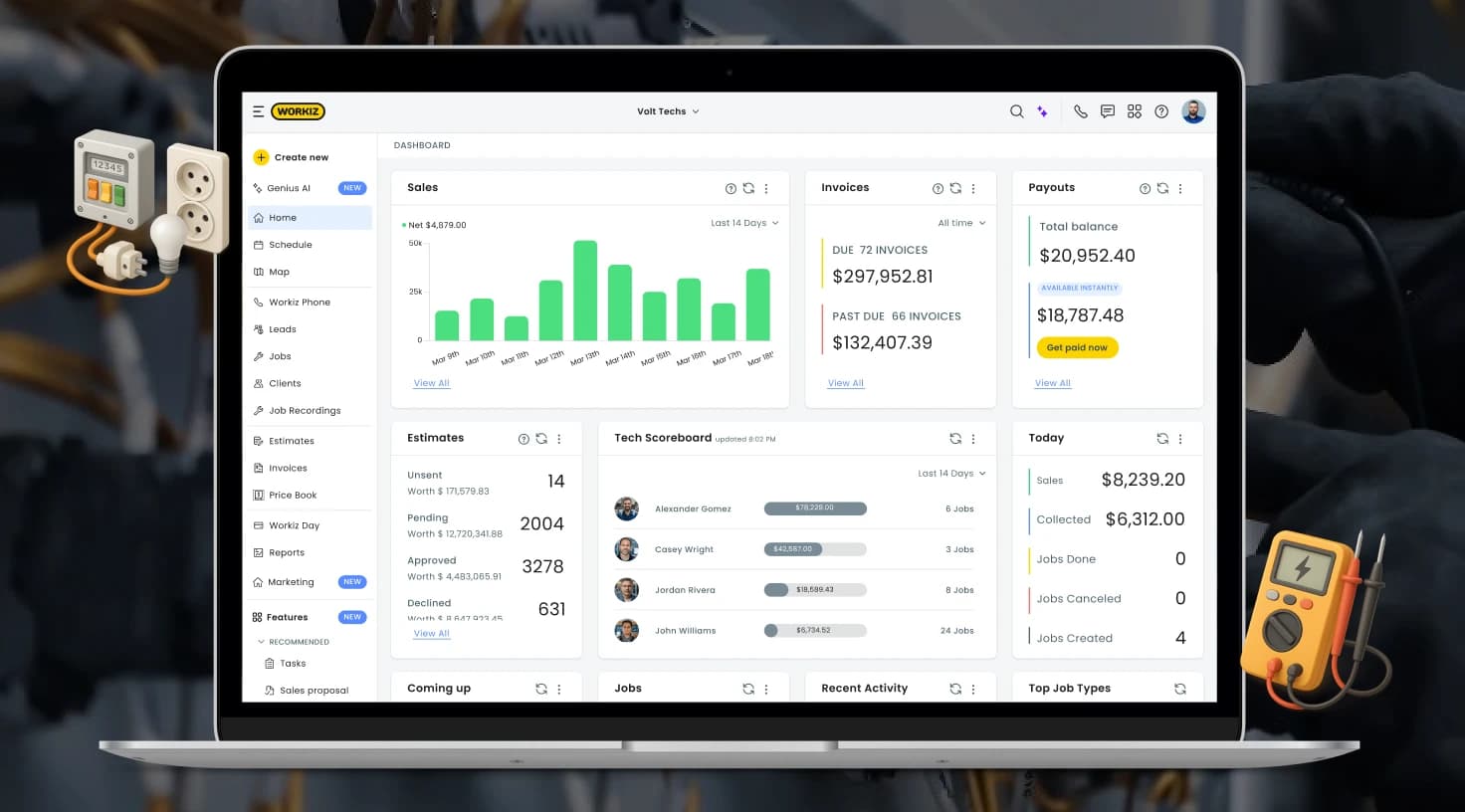
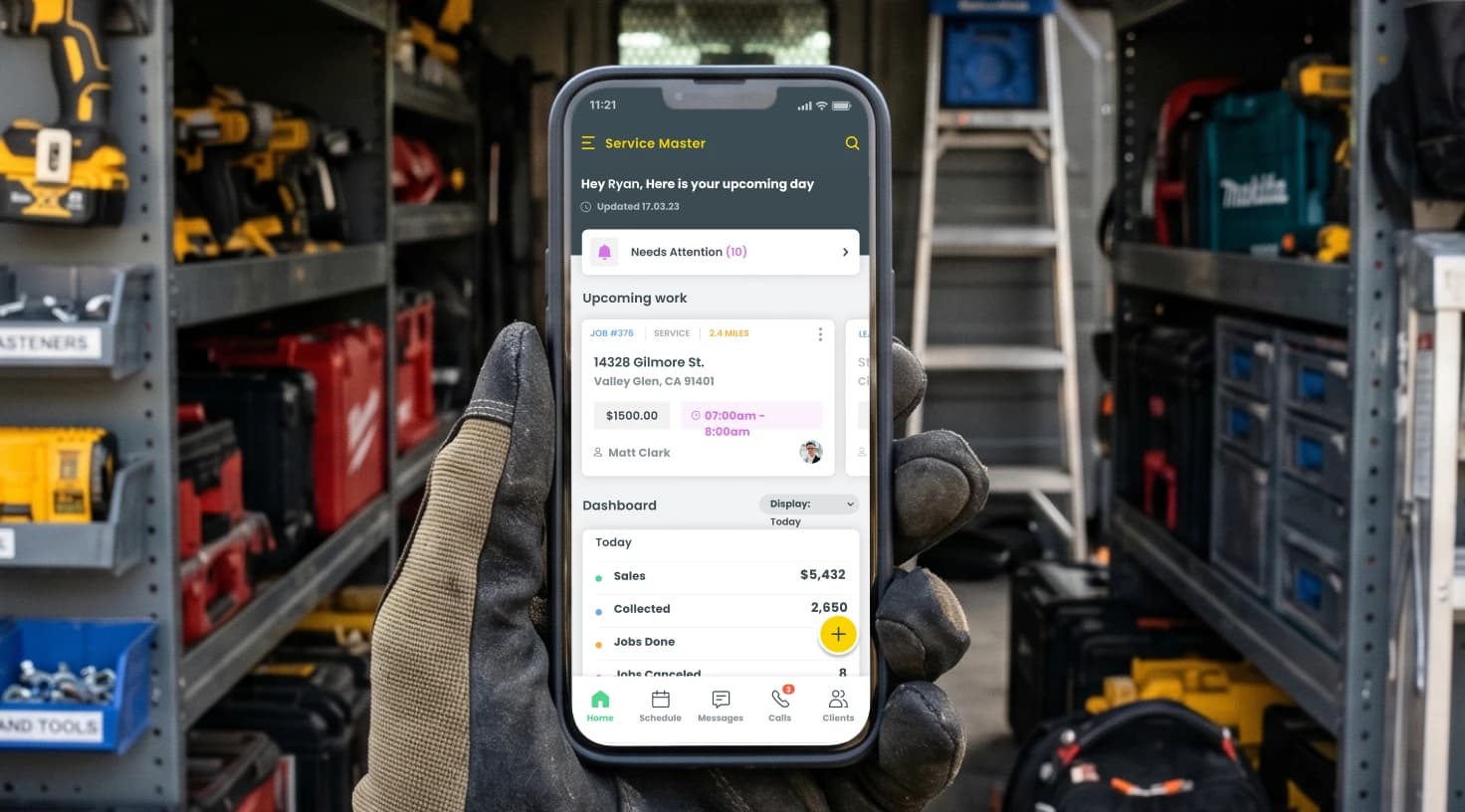
Managing a growing electrical business in Mississippi can be challenging amid complex fieldwork and endless administrative tasks. Fortunately, Workiz provides a specialized field service management platform designed to help pros streamline everything from scheduling to invoicing.
Key benefits for Mississippi pros
Transform your electrical operations today
Ultimately, obtaining your Mississippi electrician license is just the first step toward long-term success. To truly thrive in the competitive electrical trade, you must leverage modern tools that eliminate administrative bottlenecks. Consequently, adopting an all-in-one management platform allows you to scale your business while maintaining the high safety standards required by the state.
Conclusion: Building a secure future in Mississippi's electrical trade
Navigating the path to a Mississippi electrician license demands commitment, but advancing from journeyman foundations to master expertise yields substantial rewards. By meeting the 8,000 -hour experience thresholds, acing the state exams, and following official application protocols, you will join a respected profession essential to the state's progress. Tools like the Mississippi electrician license lookup ensure transparency, while ongoing compliance keeps your career on track.
Looking ahead, Mississippi's booming construction sector, including renewable energy projects, promises significant growth for licensed professionals. Invest in your education, leverage resources like the State Board of Contractors, and consider tools like Workiz to scale your business operations. With diligence, your license is not just a credential—it is the key to a stable, impactful career powering the future.
For the latest updates, always consult official sources. Start your journey today and electrify your professional potential in Mississippi.