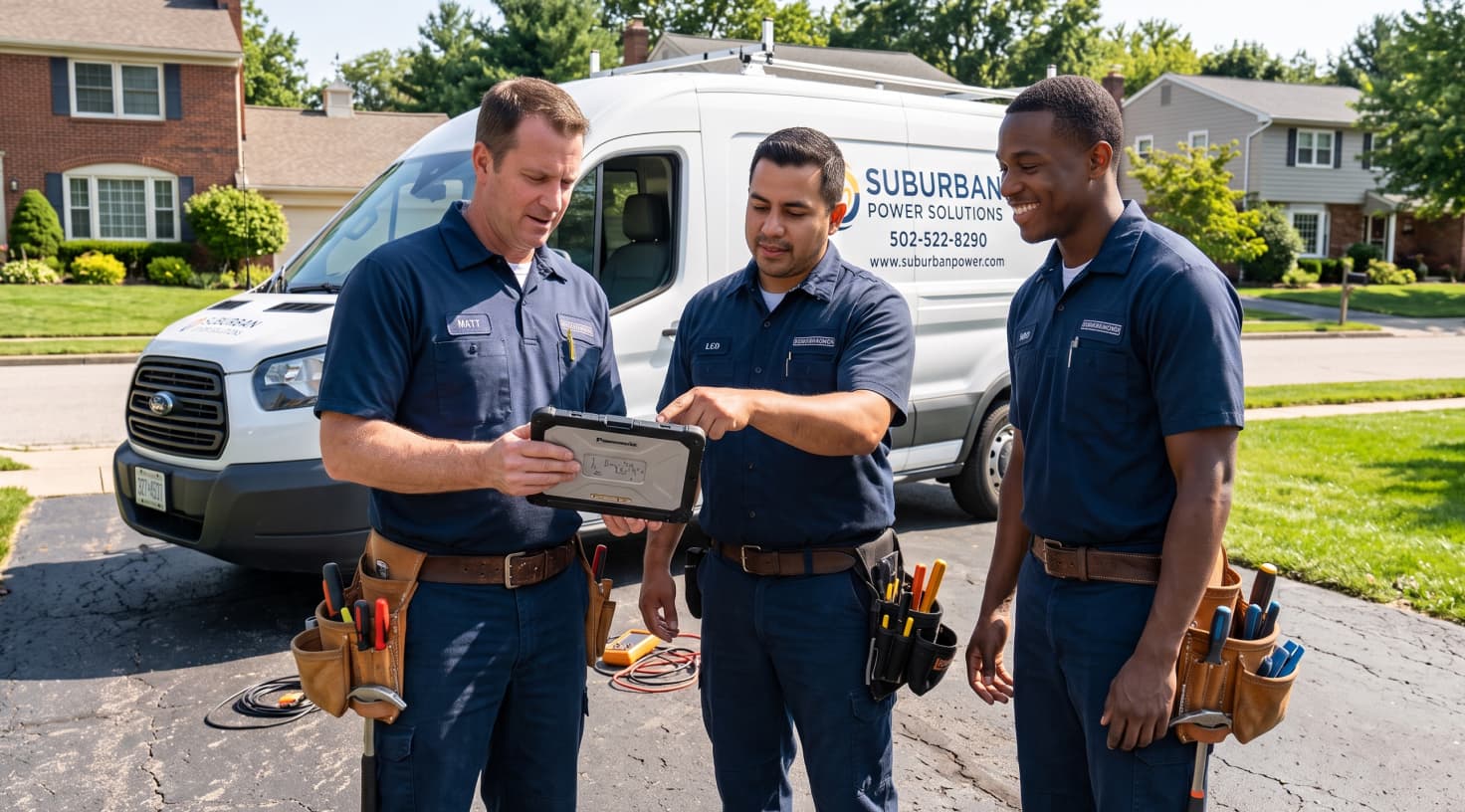

Nothing sours a service call like arguing over the bill in the customer’s driveway, and hourly billing sets up that argument on every job. A tech who finds the fault fast earns the business less for being good at the work. Overhead still has to be paid, and the homeowner spends the visit watching the clock instead of seeing what got fixed.
Electrician flat rate pricing takes the clock out of the conversation. The customer gets one fixed price before work starts, and you protect your margin on every job.
What Is Electrician Flat Rate Pricing?
Electrician flat rate pricing gives a customer one guaranteed, all-inclusive price before any work starts. Instead of watching the clock run or waiting on an unpredictable invoice at the end of the day, the client approves the exact total right in the driveway.
Every flat rate quote pre-calculates four standard components into that single number:
The technician’s loaded labor cost, including base hourly pay, payroll taxes, workers' comp, and non-billable drive time.
Standard materials and installation hardware, priced wholesale with a markup to cover warehouse carrying costs and restocking.
A proportional recovery of business overhead, covering dispatch software, shop rent, fuel, and fleet maintenance.
The shop’s target net profit margin, locked in using standard margin divisor math before tools leave the truck.
This setup removes the clock from the job entirely. Your business protects its profit margin on every ticket, fast troubleshooting gets rewarded instead of penalized, and techs never have to debate hours worked when collecting payment on-site.
How It Differs from Time-and-Materials and Hourly Billing
The difference comes down to when the customer finds out what they owe.
Hourly billing leaves the customer guessing. They pay for the time and the parts, and the total shows up when the job is done. Flat rate flips it. You scope the work, name the price, and the customer says yes before the tech starts.
Feature / Metric | Time-and-Materials (Hourly) | Flat Rate Pricing |
Pricing Timing | Quoted after job completion | Guaranteed upfront before work |
Driveway Discussions | Frequent debates over hours | Eliminated via agreed pricing |
Margin Impact | Penalizes fast, experienced technicians | Safely rewards efficient work |
Best Used For | Unpredictable, open-ended troubleshooting | Standard, repeatable electrical tasks |
Customer Experience | Anxious, clock-watching homeowners | Complete upfront cost certainty |
Why the Customer Experience Changes When Pricing Is Fixed Upfront
Under hourly billing, homeowners track everything you do. They notice:
Every trip back to the van to check inventory
Every supplier run
Every minute spent tracing a fault
A fixed price takes the clock out of it. When you quote the job before opening the panel, the homeowner stops counting minutes. Your tech stops looking like a cost running by the hour and starts looking like an advisor who knows the work.
Why Electricians Switch to Flat Rate Pricing
Owners running 5 to 50 techs usually switch because hourly billing creates the same few problems on every truck. Flat rate solves three of them directly.
Price Disputes Disappear When the Customer Agrees Before Work Starts: The customer approves the number before the tech starts, so there’s no sticker shock at the closeout. The tech takes a card payment on the spot instead of chasing an invoice for three weeks.
Experienced Techs Who Finish Faster Earn More, Not Less: Under hourly billing, your best tech swaps a panel in three hours, and you bill for three. Under a flat rate, the job pays the same, whoever does it. Speed becomes margin, and your veterans have no reason to slow down.
Good/Better/Best Upselling Becomes Natural, Not Awkward: Three clearly priced options let the homeowner steer. Maybe they pick the panel upgrade with whole-home surge protection, maybe the basic fix. Either way, your tech isn’t pushing anything, just laying out choices.
If you want a closer look at how this works in the field, Workiz has a guide on how to provide three field service estimates.
How to Calculate Flat Rate Prices for Electrical Services
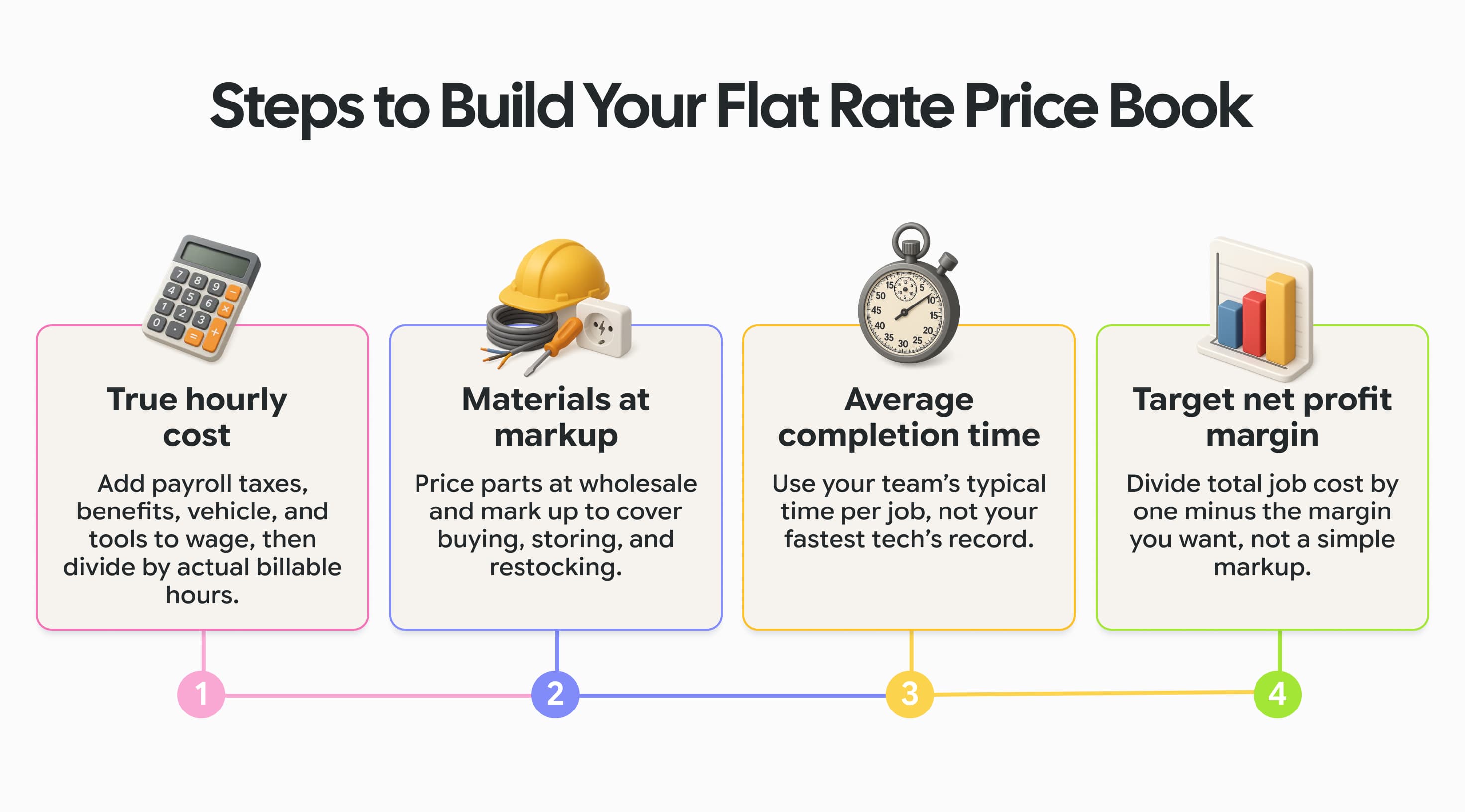
A good price book comes from your own numbers, not from copying what the shop across town charges. Work through these four steps in order.
1. Start With Your True Hourly Cost, Not Your Wage Rate
A tech’s wage is only part of what they cost you. Add payroll taxes, workers’ comp, health benefits, the truck, tools, and equipment. Then remember techs don’t bill 40 hours a week. Drive time, stocking the van, and safety meetings all eat into it.
For context, the Bureau of Labor Statistics reports a median electrician wage of $63,190 a year as of May 2025. That’s wage only. The true cost to your business is higher.
Say a tech earns $35 an hour and benefits, taxes, and vehicle costs add another $15 per paid hour. Over 2,080 paid hours, that’s $104,000. If that tech realistically bills 1,500 of those hours, the true cost is about $69 per billable hour. Your numbers will differ, so plug in your own payroll and billable hours.
2. Add Materials at Your Standard Markup
Price every part the job needs at wholesale: wire, breakers, conduit, junction boxes. Then mark it up enough to cover buying, storing, and restocking.
Small items like receptacles and wire nuts usually carry a higher percentage markup, because the handling cost per dollar of material is higher.
3. Use Average Completion Time, Not Best-Case Time
Price the job on what your team typically takes, not on your fastest journeyman’s record. If your best electrician swaps a subpanel in three hours and a newer tech needs four, set the baseline at 3.5.
That way you stay covered no matter who gets dispatched.
4. Build In Your Target Net Profit Margin
Markup and margin aren’t the same thing, and shops lose money when they mix them up. To hit a target margin, add up your labor, overhead, and materials, then divide that total by one minus the margin you want.
Say a job costs you $280 all-in and you want a 30% margin. Divide $280 by 0.70, and you get $400. If you’d just added a 30% markup instead, you’d quote $364, which is only about a 23% margin. Pick the target that fits your shop and stick to it.
What to Include in Your Electrician Flat Rate Price Book
A comprehensive price book must be organized into logical, searchable categories so dispatchers and field techs can locate fixed service codes in seconds.
Category | Typical Inclusions | Why It Matters |
Core residential services | Receptacle upgrades, switch replacements, 100/200A panel changes, dedicated circuits, recessed lighting | Steady, high-volume work that standardizes your everyday jobs |
Specialty high-ticket services | Level 2 EV charger installs, standby generators, whole-house surge protection, ceiling fans | Bigger job values and a natural base for Good/Better/Best proposals |
Diagnostic and trip fees | Initial inspection, meter diagnostics, thermal imaging, truck travel | Recovers your cost even if the customer declines the repair |
Emergency and after-hours | Weekend outages, storm repairs, urgent safety hazards | Covers overtime pay and the logistics of a late-night call |
Electrician Flat Rate Pricing Best Practices
A price book only works if the crew uses it the same way every time. These three habits keep it that way.
Start With Your 20 Most Common Services and Build from There: Don’t try to price every possible electrical job in week one. Pull your 20 most frequent jobs, things like GFCI swaps, subpanel additions, and EV chargers, and lock those first. Once your techs are comfortable quoting them, add the rarer jobs one batch at a time.
Review and Update Prices Quarterly as Material Costs Change: Copper, Romex, conduit, and breakers can all move quickly. Check your parts costs every quarter, so a supplier increase gets passed along instead of quietly cutting into profit.
Train Every Tech to Present Options, Not Quote from Memory: Quoting from memory leads to inconsistent prices. Have every tech open the price book on their phone or tablet, show the homeowner the scope, and walk through the options. It keeps pricing consistent from truck to truck, and customers see exactly what they’re choosing between.
How Workiz Helps Electricians Build, Present, and Manage Flat Rate Pricing
Keeping prices consistent across several trucks is hard on paper or spreadsheets. Workiz is built for residential trades businesses with 5 to 50 techs, and it keeps the price book, the proposal, and the invoice in one place for electrical contractors.
Pricebook Stores Your Full Flat Rate Book Digitally for Field Use: The Workiz Price Book holds your services, descriptions, parts, and prices. The techs pull it up on their phones at the job. No guessing at math in the driveway, no calling the office to ask what a service costs. It also connects to inventory management, so stock levels sit alongside your pricing.
Good/Better/Best Estimates Presented Directly From the Workiz Mobile App: Techs can build and present tiered proposals in front of the customer with Workiz estimating software. The customer sees the options side by side and picks what fits. You can also sync your proposal templates with your price book, so when you update a price, your templates follow.
Approved Estimates Convert to Invoices Automatically: Once the customer approves an estimate, it becomes a job and an invoice without anyone retyping it. Your tech can collect payment on the spot with Workiz Pay, which saves your office the weekly chase for unpaid invoices.
QuickBooks Sync Keeps Invoices, Payments, and Financials in Sync Without Manual Entry: Workiz’s QuickBooks integration syncs invoices, payments, taxes, and customer details, and you choose whether it runs automatically or manually. Your books match what the techs collected, with no double entry.
For more on how Workiz fits into the rest of the day, see this guide to electrician job management and scheduling software.