How to get your California plumbing license in 2026
California classifies plumbing licenses into several categories to match different levels of expertise and responsibility. Knowing these distinctions is key when pursuing your California plumber license. The primary licenses relevant to plumbers are issued under the C-36 Plumbing Contractor classification, but there are also journey-level certifications and apprenticeships.
Types of California plumbing licenses
A journeyman plumber is a skilled worker who has completed apprenticeship training and passed an exam, allowing them to work under a licensed contractor. In contrast, a plumbing contractor license (C-36) permits you to start your own business, bid on projects, and supervise others.
How much does a California plumbing license cost?
To help you budget for your career move in 2026, here is a breakdown of the primary costs associated with getting and maintaining your plumbing license:
Category | Estimated cost (2026) | Description |
Application fee | $450 | Non-refundable fee paid when submitting your original contractor license application. |
Contractor bond | $25,000 | The mandatory surety bond required by the CSLB to activate and maintain an active license. |
Exam fee | $60 | Charged per attempt for both the Plumbing Trade and Law and Business examinations. |
Initial license fee | $200 – $350 | Required after passing your exams to officially issue your new plumbing license. |
Renewal fee | $450 | Paid every two years to keep your license in good standing (biennial renewal). |
Average hourly rates and salary expectations (2026 data)
The path from an apprentice to a licensed contractor is paved with significant salary increases. Here is what plumbing professionals in California can expect to earn in the current 2026 market:
License level | Average hourly rate | Estimated annual salary |
Apprentice | $23.00 – $27.50 | $48,000 – $57,000 |
Journeyman | $37.50 – $47.00 | $78,000 – $98,000 |
Licensed contractor (C-36) | $55.00 – $75.00+ | $110,000+ |
Licensed contractors who use plumbing management software to automate their dispatching and invoicing often report significantly higher net profits by reducing overhead costs.
Other related classifications
Beyond the basics, California offers specialties like C-42 Warm-Air Heating, Ventilating, and Air-Conditioning Contractor, which overlaps with plumbing in some HVAC tasks. Always check if your work falls under multiple categories to avoid compliance issues.
License type | Description | Key requirements |
|---|---|---|
Journeyman plumber | Skilled tradesperson for installation and repair | 4 years experience or apprenticeship + exam |
C-36 Contractor | Business owner for projects over $1,000 | 4 years journey-level experience + exam + $25,000 bond |
Apprentice | Trainee under supervision | Registration with state; no exam |
For more details, visit the CSLB official website.
What plumbing work can be done without a license?
While California has strict regulations, there is a “handyman” exemption for very small projects. As of the 2026 updates to the California Business and Professions Code, you can legally perform plumbing work without a state license only if the total cost of the job—including labor, materials, and all other charges—is less than $1,000.
However, keep in mind that:
You cannot work on any project that requires a local building permit (like water heater replacements).
You must clearly disclose to your customers that you are not a licensed contractor.
Exceeding this $1,000 limit without a C-36 license is a misdemeanor and can lead to administrative fines of up to $15,000 for a first offense.
Journeyman plumber license requirements
Becoming a journeyman plumber in California demands a blend of practical experience, education, and certification. The journeyman plumber license in California signifies you’re qualified for complex installations and repairs, making it a foundational credential for career growth.
Experience and apprenticeship pathways
To qualify, you need at least four years of journey-level experience in the plumbing trade, which can be gained through:
Registered apprenticeship: Enroll in a state-approved program, often through unions like the UA (United Association) or non-union paths via community colleges.
On-the-job training: Work under a licensed contractor, documenting at least 8,000 hours of practical work.
Equivalent education: Combine trade school credits with experience; for example, 576 hours of classroom instruction can offset some on-the-job hours.
Apprentices must register with the Division of Apprenticeship Standards (DAS) within 20 days of starting work. This registration is free and ensures your hours count toward licensing.
Age and background checks
You must be at least 18 years old. A background check is required during application, including fingerprinting through the California Department of Justice. Felonies may disqualify you, but waivers are possible for certain offenses.
Alternative routes for experienced workers
If you have out-of-state experience, California offers formal reciprocity agreements with Arizona, Nevada, and Utah. While this can expedite the process, you will still need to pass the California Law and Business exam and meet all state-specific bonding requirements. Military veterans can apply for expedited processing under the CSLB’s veteran program.
Pro Tip: Track your hours meticulously using the CSLB’s experience verification form. Employers must verify your work, so build strong professional relationships early.
Requirements for the California plumbing license exam
The exam is the gateway to your plumber’s license in California. Administered by the CSLB, it’s a rigorous test of your knowledge in plumbing codes, safety, and practical skills. Passing it demonstrates you’re ready to protect California’s water systems and public health.
Exam content and format
Category | Details |
|---|---|
Exam type | Journeyman Plumber Exam |
Format | 100 multiple-choice questions |
Duration | 3.5 hours |
California Plumbing Code (based on the Uniform Plumbing Code)
Installation and repair techniques
Safety protocols and tools
Blueprint reading and math for plumbers
Study resources and preparation tips
Preparation is key—don’t underestimate the code sections. Recommended resources:
CSLB Study Guides: Free blueprints and sample questions available on their site.
Books: “California Plumbing Code” and “Plumbing Exam Preparation” by Mike Holt.
Courses: Online prep from providers like Plumbers Training Institute or local community colleges.
Practice exams: Apps and websites offer simulated tests to build confidence.
Scheduling and testing locations
Exams are computer-based at PSI testing centers across California. Schedule via the CSLB website or by calling 800-952-5210. Arrive with two forms of ID; no calculators are allowed, but basic math is tested.
For further reading, check the CSLB Examination Study Guides.
How to get a plumbing license in California: Step-by-Step
Once you’ve met the experience and exam requirements, applying for your license is straightforward but detail-oriented. The CSLB handles applications for the California plumber license, ensuring all paperwork is in order before issuance.
Step-by-step application guide (2026)
Follow these steps to submit your application:
Gather documentation: Proof of experience (certified by employers), exam results, high school diploma or equivalent, and fingerprint cards.
Complete the form: Use the CSLB’s Application for Original Contractor License (available online or by mail).
Pay fees: The CSLB application fee for an original contractor license is now $450.
Submit bond and insurance: Contractors must now secure a $25,000 surety bond (up from $15,000 in previous years) to activate their license.
Wait for approval: Processing takes 4-6 weeks; track status online.
Common pitfalls to avoid
Errors like incomplete experience logs can delay approval. Double-check addresses and signatures. If applying as a Responsible Managing Employee (RME), ensure your employer qualifies.
Renewal and updates
Licenses expire every two years. Renewal requires 32 hours of continuing education (CE) for contractors, focusing on codes and business practices. Fees are $450 biennially.
Download forms from the CSLB Applicants Page.
California plumbing license lookup and verification
Transparency is vital in the trades. Use California plumber license lookup tools to verify your own license or check contractors before hiring. This ensures compliance and protects against unlicensed work, which is illegal in California.
The CSLB provides a free online portal for searches:
Visit CSLB License Check.
Enter the license number, business name, or personal details.
Review status, expiration, bond info, and any disciplinary actions.
For journeyman certifications, some counties like Los Angeles require separate lookups via local building departments.
Why lookup matters
Unlicensed plumbers face fines up to $15,000 per violation. As a license holder, regular checks keep your info current, especially after address changes.
Lookup tool | Features | Access |
|---|---|---|
CSLB Online Check | License status, history, complaints | Free, 24/7 |
County Portals (e.g., LA County) | Journeyman specifics | Free, varies by county |
Phone verification | Quick status | Call 800-321-2752 |
Compliance and license maintenance tips
Getting your plumber’s license in California is just the beginning. Ongoing compliance ensures you avoid penalties and build a reputable career. California’s emphasis on safety means staying updated on codes and ethics.
Continuing education requirements
Complete 32 hours of CE every two years, including:
8 hours on California Plumbing Code updates
15 hours on trade skills
9 hours on business and law
Providers like the PHCC (Plumbing-Heating-Cooling Contractors Association) offer approved courses online and in-person.
Insurance, bonding, and reporting
Maintain general liability insurance ($1 million minimum) and a contractor’s bond. Report changes in business structure within 90 days. Violations like shoddy work can lead to license suspension—always prioritize quality.
Career advancement tips
Once licensed, consider specializing in green plumbing or medical gas systems for higher pay. Network through associations like the California Plumbing Contractors Association for job leads and advocacy.
For compliance resources, see the CSLB License Maintenance Page.
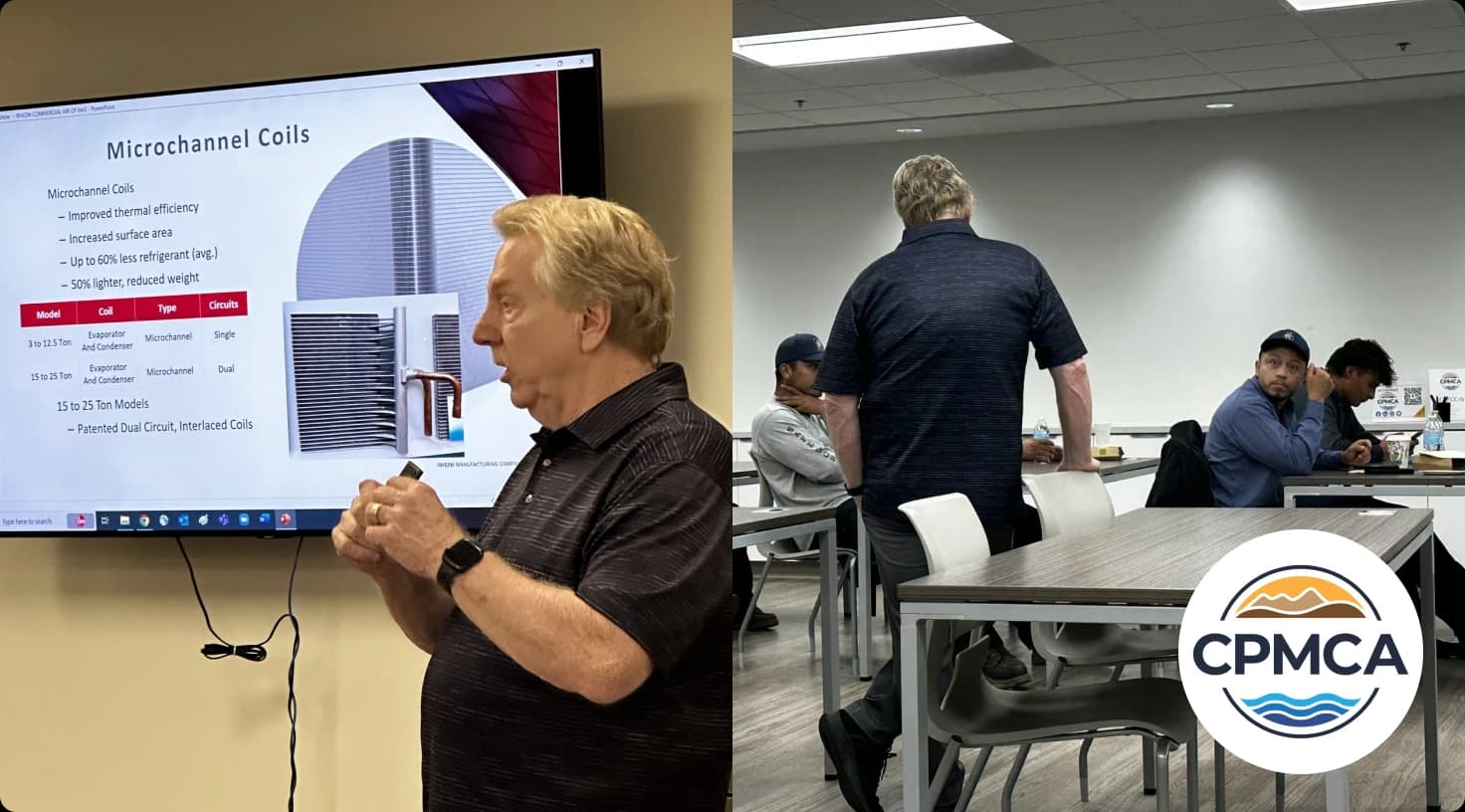
California Plumbing and Mechanical Contractors Assoc. HVAC Service Training session
California plumber salary and job outlook
California continues to show strong demand for licensed plumbers due to ongoing housing development, infrastructure upgrades, and water-efficiency initiatives. Skilled tradespeople with proper certification can expect steady employment, competitive pay, and opportunities for career growth.
Experience level | Average annual salary (USD) | Typical role description |
|---|---|---|
Entry-level plumber | $48,000–$55,000/year | Assist senior plumbers, handle basic installations, and learn California plumbing codes. |
Journeyman plumber | $75,000–$95,000/year | Perform independent installation and repair work, supervise apprentices, and ensure code compliance. |
Licensed contractor (C-36) | $105,000+/year | Operate a plumbing business, manage projects, hire staff, and bid on large-scale jobs. |
Job outlook: The California Employment Development Department (EDD) projects faster-than-average growth for plumbing positions through the next decade. Population expansion and sustainability programs continue to drive high demand for qualified, licensed plumbers across the state.
Plumber salary by state (Approx. Averages, USD)

How Workiz helps you succeed
Getting your plumbing license in California is a big deal – it's the key to turning your skills into a real business. But once you've got that license in hand, the real work begins. Running a plumbing company in California means managing schedules, customers, invoices, and all the paperwork that comes with staying compliant. That's where Workiz steps in to make your life a whole lot easier.
Workiz was built with tradespeople like plumber contractors in mind. By streamlining scheduling, dispatching, and invoicing on one platform, Workiz saves you time. Smart sales tools, like leads integration and Reserve with Google, help plumbing pros win more jobs and increase profit. Using Workiz software is a smart, simple way to work efficiently, look professional, and stay one step ahead.