Field service trade pros facing growth constraints routinely encounter the decisive software crossroads of the Jobber vs. ServiceTitan comparison. While administrative bottlenecks choke operational throughput, choosing incorrectly between an agile management tool and an enterprise operating engine threatens either immediate financial liquidity or long-term operational velocity.
Deciding between rapid platform deployment and comprehensive enterprise control requires dissecting total system costs, mobile workflows, inventory mechanics, and reporting architectures to determine which platform aligns with technical fleet demands.
Jobber Overview
Jobber operates as an intuitive, cloud-based field service management platform tailored primarily for residential trade pros and light commercial operators. Built to cut out manual paperwork and back-office busywork, the platform streamlines the core customer lifecycle:
Quote generation
Visit scheduling
Technician dispatching
Customer self-service through its Client Hub
Integrated payment processing
By emphasizing clean interface design and rapid mobile execution, Jobber allows owner-operators and small office teams to coordinate field crews without requiring specialized IT support or weeks of staff software training.
ServiceTitan Overview
ServiceTitan provides an enterprise-grade operating ecosystem engineered for scaled residential and commercial trades businesses across mechanical, electrical, and plumbing sectors. Rather than functioning merely as an operational calendar, ServiceTitan provides deep institutional infrastructure with:
Multi-tiered call booking
Real-time job costing
Dynamic pricebooks
Integrated supply-chain procurement
It is built for large, multi-truck operations needing advanced revenue attribution, technician scorecards, and automated service agreement workflows.
Jobber vs. ServiceTitan: Feature-by-Feature Breakdown
Evaluating Jobber and ServiceTitan across functional departments highlights the fundamental trade-offs between lightweight agility and enterprise operational depth.
Operational Dimension | Jobber | ServiceTitan |
Target Business Size | 1 to 20 technicians; lean, owner-led teams. | 15 to 250+ technicians; multi-division enterprises. |
Scheduling and Dispatch | Visual drag-and-drop calendar with basic routing. | Tiered dispatch board with skill-based auto-assignment. |
Mobile App Experience | Lightweight app built for rapid field updates. | Feature-dense tablet hub for complex operational workflows. |
AI and Automation Features | Jobber AI and AI Receptionist. | Titan Intelligence for dispatch routing and technician sales coaching. |
Reporting and Analytics | Standard cash flow, sales summaries, and timesheets. | Burdened job costing, gross margin tracking, and close rates. |
Integrations | Open App Marketplace, Zapier, and accounting sync. | Restricted API partner network requiring paid certification. |
Pricing Model | Transparent published tiers billed monthly or annually. | Custom per-technician monthly quotes plus implementation fees. |
Setup and Onboarding Time | Self-guided onboarding operational within 1 to 7 days. | Structured implementation requiring 12 to 16 weeks. |
Where Each Platform Earns Its Reputation
In the trades, software reputation comes down to field usability versus back-office control. Jobber made its name on speed and simplicity for lean crews. ServiceTitan built an enterprise engine for high-volume operations.
Here is where each platform delivers and where each hits real-world limits.
Where Jobber Excels
Jobber cuts out routine paperwork, so smaller teams can quote, schedule, and get paid faster.
Fast Setup and Intuitive Interface Built for Smaller Teams: Most crews pick up the mobile app in an afternoon without IT help or structured training.
Published Transparent Pricing With a 14-Day Free Trial: Clear tiers are listed upfront on the site, so you can test tools before talking to sales.
Jobber AI That Learns How You Quote and Adapts Over Time: It pulls from past estimates to auto-fill common line items, speeding up quote generation.
AI Receptionist for Call Handling Without Extra Headcount: An automated agent handles incoming calls 24/7, answering common questions and booking jobs directly to the calendar.
12 Hours Saved Per Week on Average for Jobber Users: Automating customer text reminders, estimate follow-ups, and card-on-file billing clears out roughly 12 hours of weekly busywork.
Where Jobber Has Limits
As trade businesses scale up in headcount and technical scope, Jobber’s lightweight structure starts running into operational boundaries.
Not Built for Large Multi-Division or Commercial Operations: Jobber struggles with complex commercial asset hierarchies, multi-entity corporate structures, and progress AIA billing required on large job sites.
Lighter Reporting and Analytics Depth Than Enterprise Platforms: Standard reports track overall revenue and timesheets, but lack burdened technician costing, dynamic margin analysis, and granular profit tracking.
Less Advanced Call Booking and Marketing Attribution Tools: Jobber does not provide native dynamic call tracking or phone number pools to tie incoming jobs back to specific marketing campaigns.
Fewer Native Payroll and Commission Tracking Capabilities: Managing tiered technician commissions, spiffs, and piece-rate pay structures requires manual calculations or external payroll integrations.
Where ServiceTitan Leads
ServiceTitan is the choice for owner-operators who demand total control over every truck, lead, and dollar.
Enterprise-Grade Marketing, Call Booking, and Revenue Attribution: Every inbound call links to your advertising campaigns, tracking exact customer acquisition costs and closed revenue.
Titan Intelligence and AI-Driven Coaching for Dispatchers and Techs: Smart algorithms match the most profitable technician to each job and deliver live sales prompts during field presentations.
Deep Reporting Across Revenue, Tech Performance, and Job Costing: Granular dashboards calculate true job margins by factoring in purchase orders, warehouse parts, and loaded labor rates.
Commercial and Residential Coverage Under One Roof: Field techs run quick residential service calls and complex commercial maintenance contracts within the same database.
Service Agreement Automation and Renewal Management at Scale: It automates recurring membership billing, tracks on-site equipment histories, and handles deferred revenue cleanly.
Where ServiceTitan Has Limits
That enterprise capability requires heavy administrative overhead and massive financial buy-in.
No Published Pricing: Quote Process Requires a Demo and Sales Conversation: Prices are hidden behind mandatory sales discovery calls, tailored demos, and multi-year contract locks.
Weeks of Onboarding Before Teams Can Operate Independently: Getting live takes 12 to 16 weeks of database cleaning, pricebook setup, and intensive staff training.
Per-Technician Pricing Model Can Scale Costs Quickly: Per-technician pricing, which ServiceTitan does not publish publicly, can scale costs significantly as teams grow, particularly for businesses adding seasonal staff or new routes.
Core AI Features Gated Behind Pro Tier Add-Ons at Extra Cost: Critical capabilities like Phones Pro, Marketing Pro, and AI dispatch intelligence require expensive plan upgrades.
Integration Dependencies That Can Create Sudden Operational Disruption: A gated, closed API limits third-party software options and risks immediate workflow disruption whenever partner agreements shift.
Which Operation Is Each Platform Built For
Selecting software in the trades is never about choosing the platform with the most checkboxes; it is about matching software complexity to your actual fleet size and back-office capacity.
Jobber: Best for Small to Mid-Sized Teams That Need to Move Fast
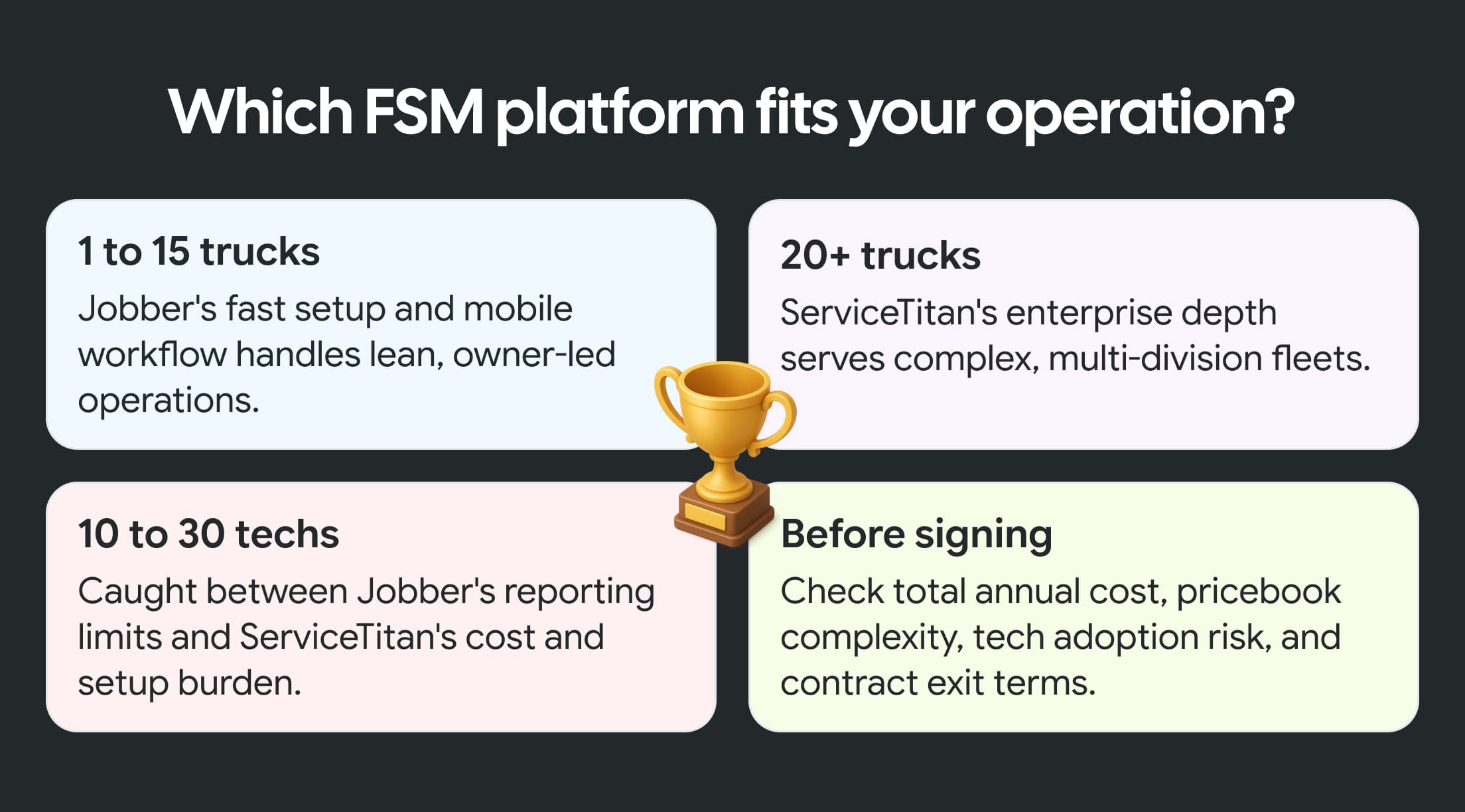
Jobber fits residential contracting businesses operating 1 to 15 trucks. In these companies, owners frequently split time between the field and the office, requiring software that dispatches technicians, quotes on-site, and collects payment without getting bogged down in routine admin.
ServiceTitan: Best for Large, Complex Operations With Dedicated Office Staff
ServiceTitan serves scaled commercial and residential trades businesses operating 20 or more service vehicles. At this scale, organizations employ dedicated dispatchers, full-time pricebook administrators, and marketing managers who actively exploit deep capacity planning and granular job costing engines.
When Teams Between 10 and 30 Technicians Hit the Crossroads
Trade pros fielding 10 to 30 technicians face a difficult strategic dilemma. At this inflection point, Jobber's lighter reporting and lack of multi-location inventory create administrative bottlenecks. Conversely, absorbing ServiceTitan's steep licensing overhead and prolonged setup period introduces severe financial strain on mid-sized balance sheets.
What to Ask Before Signing Either Contract
Owner-operators evaluating either software system must address four essential operational questions:
What is the fully burdened annual software cost, including implementation fees, add-on modules, and card processing rates?
Does the back-office team have the bandwidth to configure and maintain complex digital pricebooks?
Will field technicians consistently complete multi-step mobile tablet workflows without administrative resistance?
What contractual terms govern data exports, API accessibility, and contract cancellations?
The Trade-Off Both Platforms Ask You to Make
Every field service software platform requires compromising between operational simplicity and analytical depth.
Decision Factor | Jobber Compromise | ServiceTitan Compromise |
Usability vs. Depth | Maximizes field usability but limits deep job costing and inventory tracking. | Delivers deep financial analytics at the cost of steep interface complexity. |
Scaling Cost | Low base subscription fees that require external add-ons as needs mature. | High per-technician licensing that inflates fixed overhead during growth. |
Ecosystem Stability | Relies on third-party marketplace apps for specialized phone and marketing workflows. | Enforces a closed API model vulnerable to partner lockouts and sudden policy shifts. |
Field Execution Risk | Fast technician adoption paired with manual back-office margin calculations. | Requires rigid technician compliance to avoid distorting reporting dashboards. |
Why Growing Field Service Teams Consider Workiz Instead
To bridge the gap between simple schedulers and heavyweight enterprise suites, many residential trade pros turn to Workiz.
Core Features Built Natively, Not Through Third-Party Agreements: Workiz provides integrated VoIP phone systems, visual drag-and-drop dispatching, and field payments in one unified platform.
Transparent Pricing With No Demo Required: Simple subscription tiers let owner-operators evaluate software costs upfront without sitting through high-pressure enterprise sales pitches.
Full Genius AI Suite Across Calls, Scheduling, and Marketing: Built-in AI agents answer incoming calls, streamline job dispatching by matching new jobs to available technicians, schedule visits, and automate marketing follow-ups.
Onboarding in Under Two Weeks: Field teams can transition operations without experiencing business downtime or prolonged deployment cycles.
Built for 5 to 50-Tech Residential Trade Businesses: Engineered for locksmiths, garage door specialists, plumbers, and HVAC operators looking to expand profitably.