
Imagine getting an email on a hot August morning telling you that the messaging tool your dispatchers rely on every hour is shutting down in less than 30 days. No transition support, no warning, and no migration window. Just a 30-day countdown clock right in the middle of peak HVAC season, while your office phones are ringing off the hook, and your technicians are running from one emergency call to the next.
That isn't a hypothetical horror story. It actually happened to nearly 1,000 residential service businesses when ServiceTitan suddenly announced it was ending its integration with Podium. Contractors who spent years building their customer texting, automated review requests, and speed-to-lead follow-ups around that connection were instantly left scrambling for a workaround.
This sudden fallout exposed a massive flaw in how many software stacks are built. When your critical business functions depend on external partner bridges, your daily operations are vulnerable to corporate disputes you can't control. For owner-operators evaluating a dependable ServiceTitan alternative, this incident serves as a clear lesson: core business features should never depend on third-party integrations.
What Happened When ServiceTitan Cut Off Its Podium Integration
To understand why relying on third-party integrations puts field operations at risk, you only have to look at how quickly a foundational software relationship dissolved. When two major software vendors part ways, contractors find out firsthand how fragile external integrations really are.
Nine Years of Partnership, Ended in Under 30 Days
For nearly a decade, Podium and ServiceTitan operated as a primary communication bridge for home service shops. In August 2026, ServiceTitan notified contractors that the integration would be decommissioned in four weeks.
Podium leadership noted they were blindsided, proving that long-standing software partnerships can vanish overnight when commercial alignments shift.
Nearly 1,000 Businesses Scrambling in Peak HVAC Season
August brings peak call volumes for trade contractors as heatwaves trigger emergency calls, a seasonal operational surge monitored closely by trade groups like the Plumbing-Heating-Cooling Contractors Association (PHCC). Forcing nearly 1,000 service businesses to research, buy, and configure a new messaging tool during their busiest season created immediate administrative friction and risked lost revenue.
The timing made a bad situation much worse. August brings the year's heaviest call volume across the home services industry. Record summer heat pushes cooling systems to failure, keeping technicians fully booked, and administrative staff pushed to their limit.
Why the Timeline Was the Real Problem, Not the Decision Itself
A 30-day deprecation window is structurally insufficient for field operations. Replacing a messaging hub requires exporting client records, remapping triggers, rerouting phone numbers, and retraining dispatchers.
Executing that overhaul in four weeks without dropping customer calls is nearly impossible during peak season.
Why Even Strong Integration Partnerships Can Fall Apart
Contractors often assume that if two major software companies partner up, the connection is permanent. In reality, external integrations are fragile commercial arrangements governed by changing financial incentives, technical control conflicts, and shifting corporate agendas.
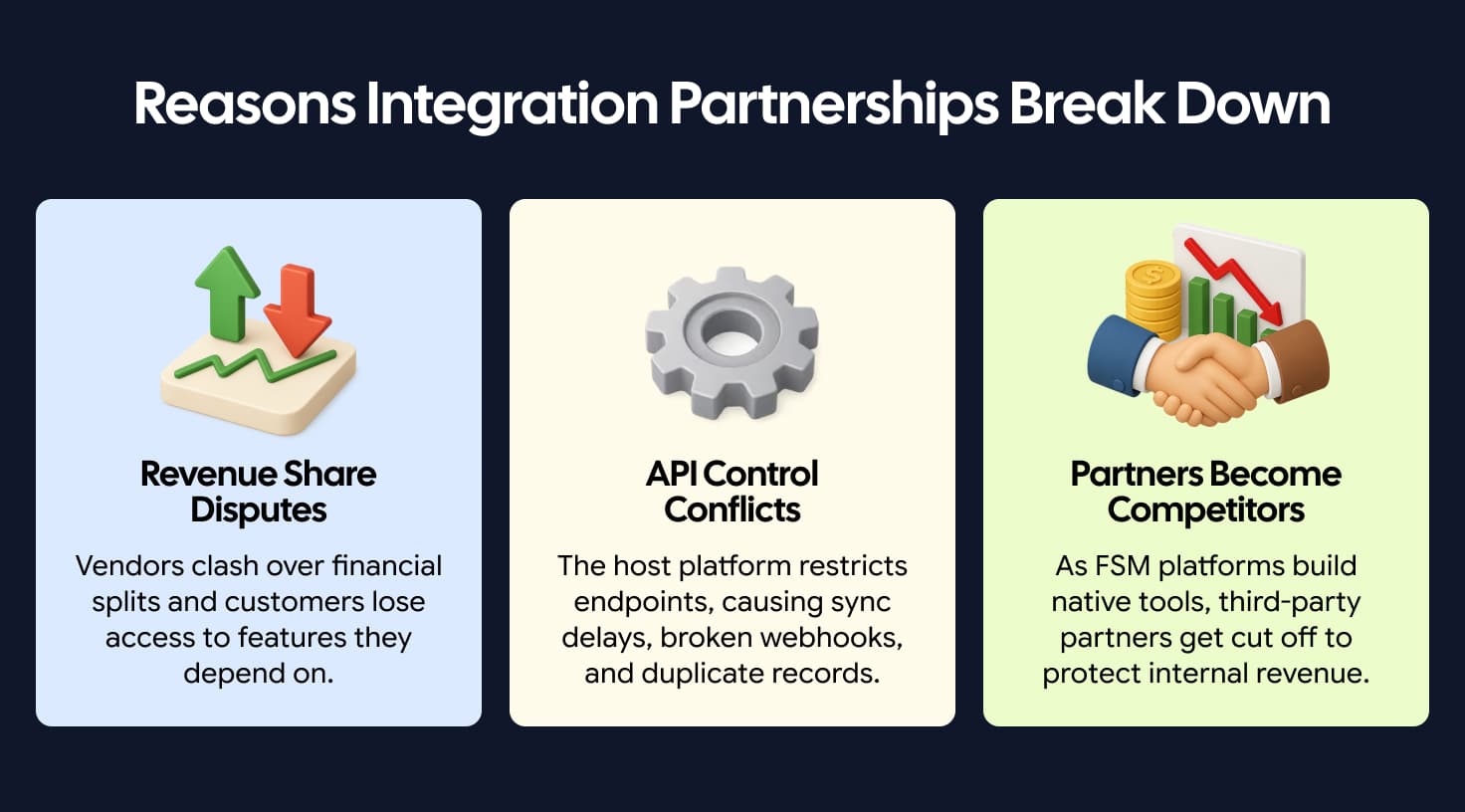
Revenue Share Disputes Put Customers in the Middle: FSM platforms monetize app ecosystems through partner certification fees and revenue shares. When vendors clash over financial splits, integrations are severed or reclassified as unsupported custom connections, leaving paying customers trapped in corporate disputes.
API Control Conflicts Limit What Partners Can Build: The host platform controls API access levels, sync speed, and data limits. If an FSM vendor restricts endpoints to protect its ecosystem, third-party integrations suffer from sync delays, broken webhooks, and duplicate customer records.
Commercial Tensions Between FSM Platforms and Their Partners: As FSM platforms build internal tools like SMS, VoIP, and AI, third-party partners transform into direct commercial competitors. The platform then has strong financial incentives to adjust integration policies or shut down partner access entirely.
The Difference Between Native Features and Bolted-On Integrations
Understanding the technical gap between native software architecture and bolted-on third-party tools is key to keeping your business stable. While integrated setups rely on external partner agreements, middleware bridges, and fragile API syncs, native features are engineered inside a single codebase to protect your data and prevent sudden operational shutdowns.
Feature Dimension | Native Platform Architecture | Bolted-On Third-Party Integration |
System Ownership & Codebase | The platform owns technology end to end within a single codebase and database. | Relies on separate software applications connected via external API bridges. |
Agreement & Deprecation Risk | Zero risk of feature removal due to third-party partner contract disputes. | High risk of sudden partner deprecation, contract breakups, and 30-day shutdown notices. |
Commercial & Financial Risk | Transparent single subscription bill with no hidden third-party access fees. | Hidden commercial risks, separate monthly invoices, API charges, and forced tier upgrades. |
Data Sync Speed & Health | Real-time, instant updates across dispatch, customer records, and billing. | Prone to API sync delays, rate limit throttling, broken webhooks, and record drift. |
Support & Accountability | Single point of contact and support team responsible for the entire platform. | Fragmented support with vendors blaming each other when features break or drop data. |
AI Context Depth | Direct, unrestricted access to CRM logs. | Restricted API access bounded by partner rules. |
The Real Cost of Losing a Critical Third-Party Integration
When a critical software bridge gets severed, the damage strikes at the heart of your daily operations. From lost communication histories to broken automated triggers, relying on fragile partner bridges creates silent friction that stalls technicians and leaks revenue across your entire system.
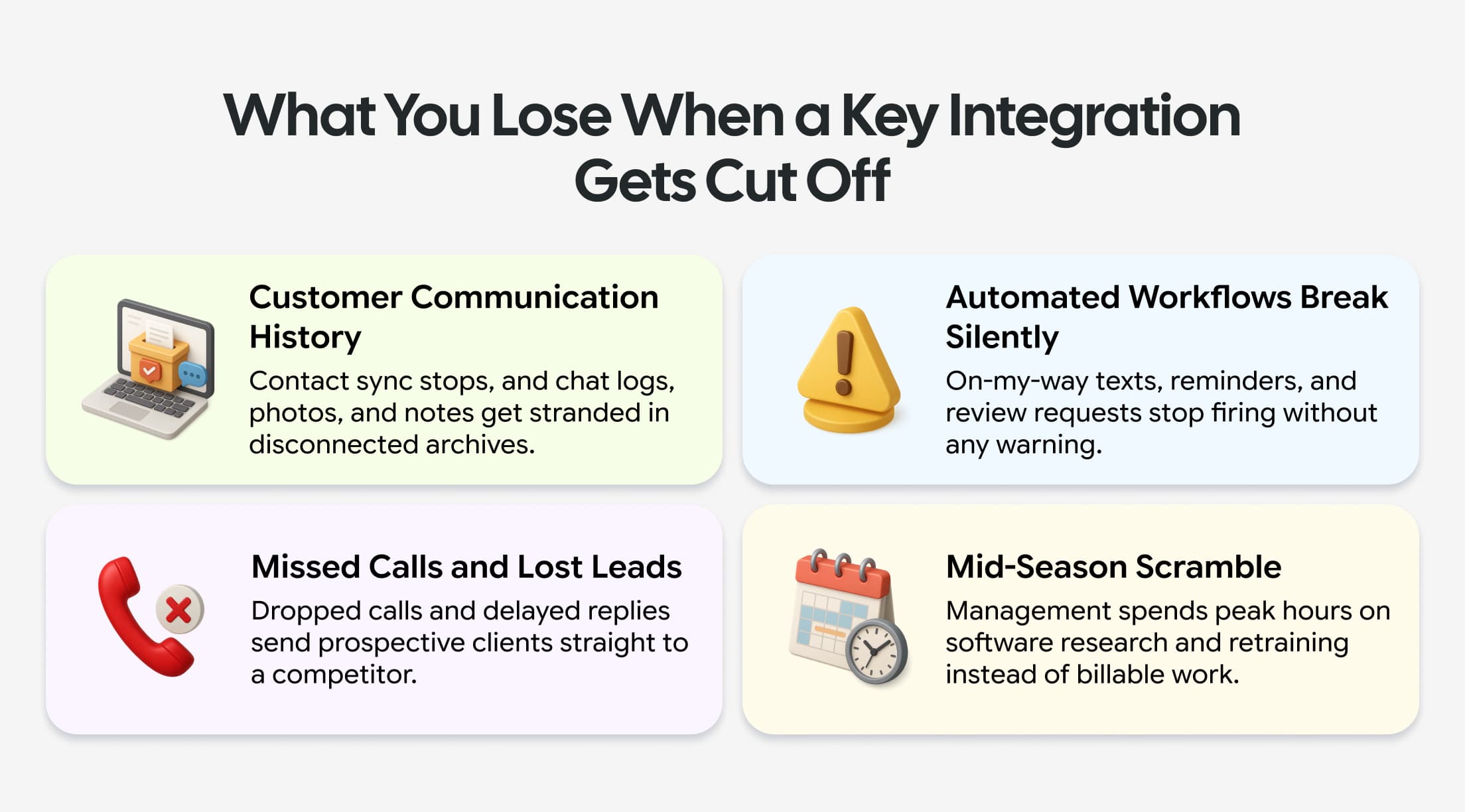
Customer Communication History and Two-Way Contact Sync: Disconnecting a messaging tool halts contact synchronization. New leads stop flowing to the CRM, and historical chat logs, photos, and notes become isolated in disconnected archives.
Automated Messaging, Review Requests, and Follow-Up Workflows: Automated "on-my-way" texts, appointment reminders, and post-job review requests rely on real-time triggers. Broken integrations silently stop these workflows, damaging review volume and customer satisfaction.
Inbound Call Handling and Lead Capture from Phone Channels: Inbound leads require immediate action. If disconnected phone or messaging integrations drop calls or delay text replies, prospective clients hang up and call the next contractor on Google.
Time and Revenue Lost Scrambling Mid-Season for a Replacement: Business owners waste high-value hours evaluating replacement software, remapping data, and retraining staff during peak revenue season, pulling management away from billable job execution.
Before You Choose an FSM Platform, Ask These 4 Questions
Evaluating core software architecture is essential for long-term risk management. Guidance from the U.S. Small Business Administration emphasizes that securing operational continuity and owning core vendor relationships are critical steps to avoiding single points of failure.
When looking for software and evaluating top ServiceTitan competitors, look past flashy sales demos and ask these four direct questions to protect your operations:
Which core features are native vs. powered by a third-party partner?
Ask vendors to specify which features - messaging, phone, dispatching, invoicing, and AI - are native versus provided by external partners.
What happens to your data if a key integration is discontinued?
Confirm whether communication records and job notes remain permanently accessible in your CRM if an integration ends.
Does the platform own its own phone system, messaging, and payments?
Verify that the provider owns its telephony infrastructure and payment processing rather than relying on third-party add-ons.
Is the AI built in-house or resold from an external provider?
Ensure AI capabilities are engineered into the core database rather than resold through fragile third-party API wrappers.
One Platform, No Third-Party Dependencies: How Workiz Built Its Core Features
Workiz was built for SMB residential service businesses running 5 to 50 technicians across HVAC, plumbing, electrical, garage door, locksmith, and appliance repair verticals. By building core features natively, Workiz eliminates third-party dependencies.
No Partnership Behind the Phone System or Messaging
Workiz includes a native communication platform. Genius Phone provides built-in VoIP telephony, call recording, queues, number masking, and lead attribution directly on the dispatch board with zero partner contract risk.
Workiz Pay and Consumer Financing Integrated at the Platform Level
Financial tools in Workiz are native to the mobile app. Workiz Pay lets technicians generate estimates, accept card payments, process Tap-to-Pay, and offer Wisetack consumer financing directly in client driveways, syncing cleanly with QuickBooks.
One Platform That Owns Your Data End to End
Workiz unifies scheduling, dispatching, CRM, multi-van inventory, and invoicing in a single database, eliminating data drift and duplicate entry.
Workiz AI Is Built In, Not Bolted On
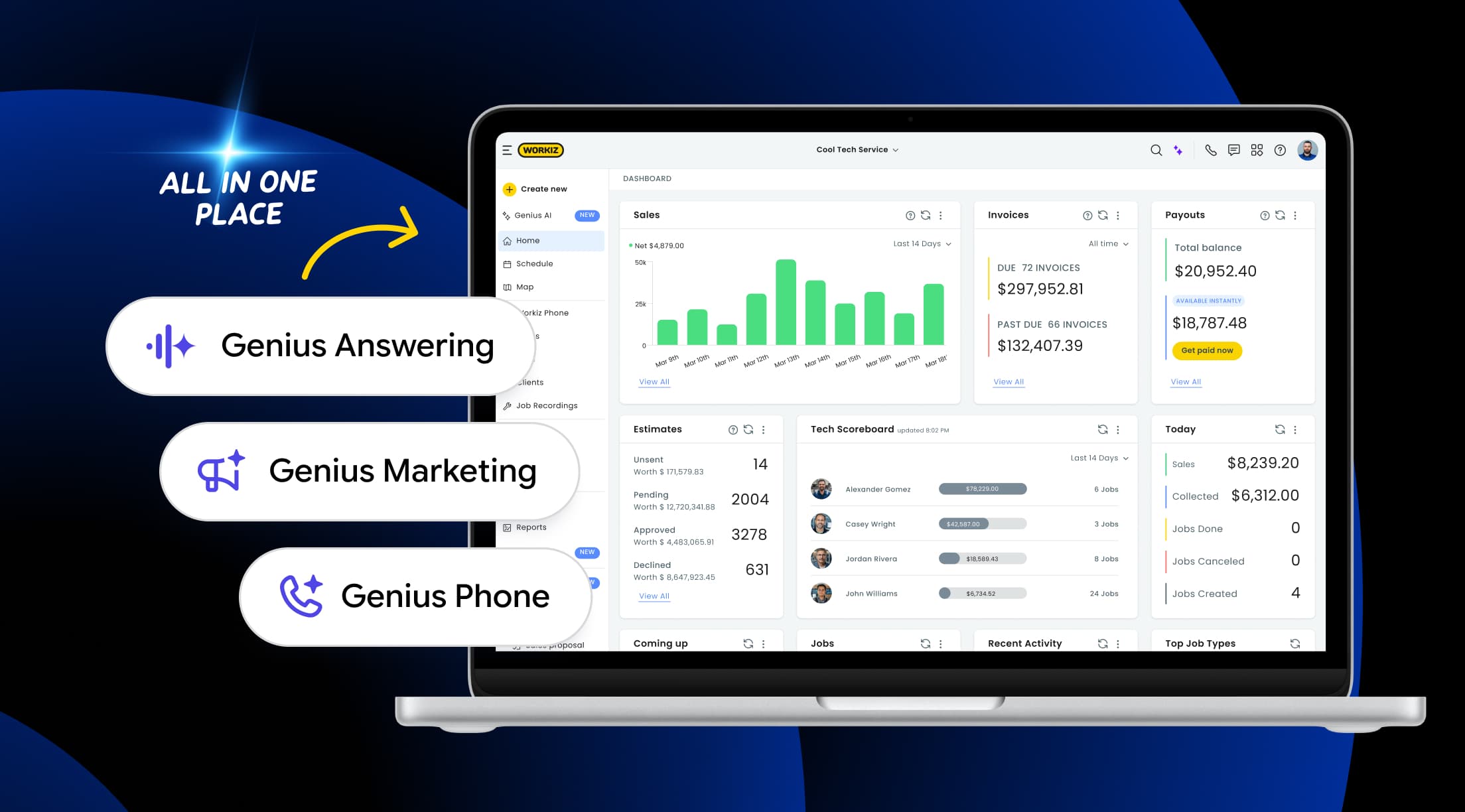
Genius Answering, Genius Phone, and Genius Marketing Are All Native: The Genius AI suite is proprietary technology engineered into Workiz. Genius Answering comes with a 24/7 AI virtual receptionist that fields calls, qualifies leads, and books jobs onto the dispatch board. Genius Phone provides call intelligence, while Genius Marketing triggers automated estimate follow-ups. Genius Phone's Smart Messaging feature uses live job and customer history to help your team compose accurate, contextual replies instantly without switching platforms.
No Third-Party AI Partner Agreement Means No Overnight Shutdown Risk: Because Genius AI is owned entirely by Workiz, its availability is guaranteed by the platform with zero risk of partner contract cancellations.
Every Genius Feature Shares the Same Data, the Same Platform: Native AI design allows Genius features to access real-time schedules, job history, and inventory levels from a single database rather than pulling from disconnected external sources.