What is an HVAC license in North Carolina?
An HVAC license in North Carolina certifies that a contractor possesses the technical skills to install, maintain, and repair complex climate control systems. The North Carolina State Board of Examiners of Plumbing, Heating, and Fire Sprinkler Contractors (PHS Board) regulates this industry to ensure public safety and maintain high professional standards. Consequently, this license serves as your company's primary credential when bidding on high-value contracts.
In 2026, state regulations mandate that companies must hold a valid HVAC license North Carolina requires to legally perform work exceeding $30,000. Furthermore, this requirement applies to all residential, commercial, and industrial projects. Obtaining a license also simplifies the process of securing essential insurance and bonding, which significantly reduces liability for your business and your clients.
Strategic advantages of licensure for contractors
For further reading, visit the official North Carolina PHS Board website.
Types of HVAC licenses in North Carolina
North Carolina offers several license classifications tailored to the specific scope of work and project scale. Understanding these categories is essential for determining which path aligns with your company's expansion goals.
Standard HVAC contractor license
The primary credential for most firms is the Heating Group (H) license issued by the PHS Board. This classification covers the installation, maintenance, and repair of heating and air conditioning systems. Consequently, the board divides this license into limited and unlimited categories based on the financial complexity of your projects.
Limited Heating License (LH): For projects up to $30,000, suitable for smaller residential jobs.
Unlimited Heating License (UH): No project value limit, ideal for commercial and large-scale work.
Other related classifications
Beyond standard heating, your business might require additional endorsements if your services overlap with other trades. For instance, refrigeration-focused professionals may need a separate state refrigeration license. Furthermore, specialized projects might involve plumbing or fire sprinkler components.
License Type | Scope | Project Limit | Typical Use |
|---|---|---|---|
Limited Heating (LH) | Installation/repair of HVAC systems | Up to $30,000 | Residential homes |
Unlimited Heating (UH) | Full HVAC services | No limit | Commercial buildings |
Heating and Air Conditioning (HA) | Combined heating/cooling systems | Varies | Integrated systems |
North Carolina HVAC license requirements
Meeting the North Carolina HVAC license requirements involves more than technical skill. You must prove your company is financially and operationally stable. In 2026, the PHS Board enforces strict standards to ensure every licensed firm can handle professional liability.
Education and experience
The board prioritizes proven on-site expertise over theoretical knowledge. Therefore, your business must appoint a qualifying party. This person represents the technical competence of your firm. They must meet the following criteria:
Field experience: You must document four years of full-time experience under a licensed contractor. At least two of these years must focus specifically on HVAC systems.
Educational credits: You can substitute up to two years of experience with a degree from a technical program.
Daily involvement: The qualifying party must stay active in your company's daily operations. This ensures your license remains valid and compliant.
Financial and insurance requirements
Financial health is a key requirement for the 2026 licensing process. The board sets specific benchmarks to protect your assets and your clients.
Financial metric | Limited license | Unlimited license |
Minimum net worth | $25,000 | $150,000 |
General liability | $1,000,000 | $1,000,000+ |
Surety bond | $50,000 | $150,000 – $5,000,000 |
Financial report | Basic statement | CPA-audited report |
You must also provide proof of workers' compensation insurance if you have three or more employees. These financial standards allow your business to bid on high-ticket commercial projects.
Age and background checks
All applicants must be at least 18 years old. In addition, you must pass a comprehensive criminal background check. The board reviews each case individually. However, crimes involving fraud or safety violations can lead to disqualification. You should stay transparent during the application process to avoid delays. Furthermore, you can find the latest 2026 compliance forms on the PHS Board requirements page.
North Carolina HVAC license application process
Completing the North Carolina HVAC license application requires careful planning and precise documentation. The PHS Board manages this multi-step procedure to verify the legitimacy of your business. Consequently, you should start the process early. Processing times typically range from 2 to 6 weeks in 2026.
Step-by-step guide
Gather documentation
Collect experience verification forms signed by licensed supervisors. You must also prepare educational transcripts, current financial statements, and proof of insurance.Complete the application form
Download the latest version from the official PHS Board application page. Clearly specify your desired classification, such as Limited (LH) or Unlimited (UH).Pay required fees
Submit the application fee, which ranges from $100 to $200. Furthermore, remember that exam fees are separate and cost between $80 and $150 per section.Submit to the PHS Board
Upload your documents directly through the secure online portal for faster processing. Alternatively, you can mail physical copies to their office.Await board review
The board will verify your qualifications and financial standing. Therefore, be ready to provide additional information if they request further clarification.Schedule your exam
Register for your test through PSI Services once the board approves your application.Receive your license
The board issues your license after you pass the examination. Furthermore, you must renew this credential every year to stay compliant.
HVAC license exam details in North Carolina
The examination acts as the final hurdle in the licensing process. It validates your technical expertise and your understanding of state code compliance. PSI Services administers this computer-based test at various locations across the state. Consequently, you can choose a testing center and schedule that best fits your business operations.
Exam structure
The North Carolina Heating Contractor exam tests two distinct areas of competency. You must achieve a minimum score of 70% on each section to qualify for licensure.
Technical section: This portion includes 80 questions covering HVAC systems, refrigeration, electrical components, and piping. You have four hours to complete this segment. In 2026, expect questions regarding the transition to A2L refrigerants and new energy efficiency mandates.
Business and law section: This section consists of 50 questions focused on North Carolina regulations, labor laws, contracts, and workplace safety. You have two hours for this part.
Preparation tips
Proper preparation reduces the risk of project delays due to failed attempts. Therefore, you should utilize professional resources and study groups to ensure success.
The total cost for the exam is $120. Furthermore, you must book your seat in advance through the PSI online portal to secure your preferred date.
Section | Questions | Time | Topics covered |
|---|---|---|---|
Technical | 80 | 4 hours | Systems, codes, installation |
Business/Law | 50 | 2 hours | Regulations, safety, finance |
North Carolina HVAC license reciprocity
If you already hold a license in another state, North Carolina HVAC license reciprocity offers a faster route to market entry. The PHS Board maintains agreements with specific states to waive the technical exam for qualified contractors. Consequently, this process significantly reduces the time and cost required to launch your operations in North Carolina.
Eligible states
Reciprocity typically applies to states with licensing standards that match or exceed those in North Carolina. In 2026, the recognized states include:
South Carolina
Georgia
Virginia
Tennessee (limited)
To qualify for an exam waiver, you must meet several strict criteria. First, you must hold an active, equivalent license in your home state for at least one consecutive year. Second, you must submit formal verification from your home state licensing board. Furthermore, your business must still meet all North Carolina-specific financial and insurance requirements. You should also remember that federal EPA Section 608 certification does not grant state reciprocity; it remains a separate federal mandate.
Application for reciprocity
The application for reciprocity requires a specialized filing separate from the standard exam path.
Therefore, you should ensure your home state license is in good standing before initiating this process. For the most current list of reciprocating boards, visit the official PHS Board reciprocity page.
North Carolina HVAC license lookup
Maintaining compliance requires regular monitoring of your company's license status. Furthermore, the North Carolina HVAC license lookup tool allows you to verify the credentials of subcontractors or potential new hires. This public database serves as an essential resource for contractors to ensure every technician on a job site remains legally authorized to work.
How to use the lookup tool
The PHS Board provides a streamlined digital portal for all license searches. You can verify information by following these steps:
Visit the official website: Navigate to the PHS Board search portal.
Input search criteria: Enter the specific license number, the business name, or the name of the qualifying party into the search bar.
Review the results: Examine the current status to confirm the license is "Active." In addition, you can check for specific classifications, expiration dates, and any past disciplinary actions.
This transparency helps build trust with your clients. Consequently, many successful firms integrate their lookup results directly into their marketing materials. This practice proves your professional standing and commitment to safety.
Furthermore, you should use this tool to monitor your own renewal deadlines. Failing to track expiration dates can lead to an "Inactive" status, which immediately halts your ability to pull permits. You can access the online lookup tool here.

Maintaining your North Carolina HVAC license
Securing your license is only the first step. You must prioritize ongoing upkeep to ensure your business remains operational and legally compliant. In 2026, the PHS Board requires biennial renewals. Consequently, you must submit all necessary documentation by May 31 of even-numbered years.
Renewal process
The renewal procedure validates that your firm continues to meet state technical and safety standards. Therefore, you should prepare your records well in advance of the deadline.
Continuing education (CE): You must complete six hours of approved CE annually, totaling 12 hours per renewal cycle in 2026. These courses cover updated mechanical codes, workplace safety, and business practices. Furthermore, you must select providers approved by the board, such as ACCA or local community colleges.
Renewal fees: The board currently charges $150 for individual licenses and $300 for firms.
Insurance verification: You must submit updated certificates of general liability and workers' compensation insurance. Consequently, failing to prove active coverage will result in a renewal denial.
Late renewal penalties: You can renew within a 90-day grace period by paying a $50 penalty. However, if you miss this window, the board requires you to reapply for licensure entirely.
Common compliance issues
Business owners often face license suspensions due to avoidable administrative oversights. Therefore, you should implement a system to track the following:
Furthermore, staying informed through board newsletters helps you anticipate regulatory changes. Maintaining a clean compliance record protects your company's reputation and ensures you can continue to pull permits for large-scale projects.
Tools for success: Streamlining your HVAC business with Workiz
Operating a licensed HVAC firm in North Carolina involves managing complex schedules, high-value inventory, and diverse teams. Before implementing advanced tools, you must ensure your company has a solid foundation for growth. For a comprehensive strategy on expansion, we recommend reviewing our HVAC business plan guide.
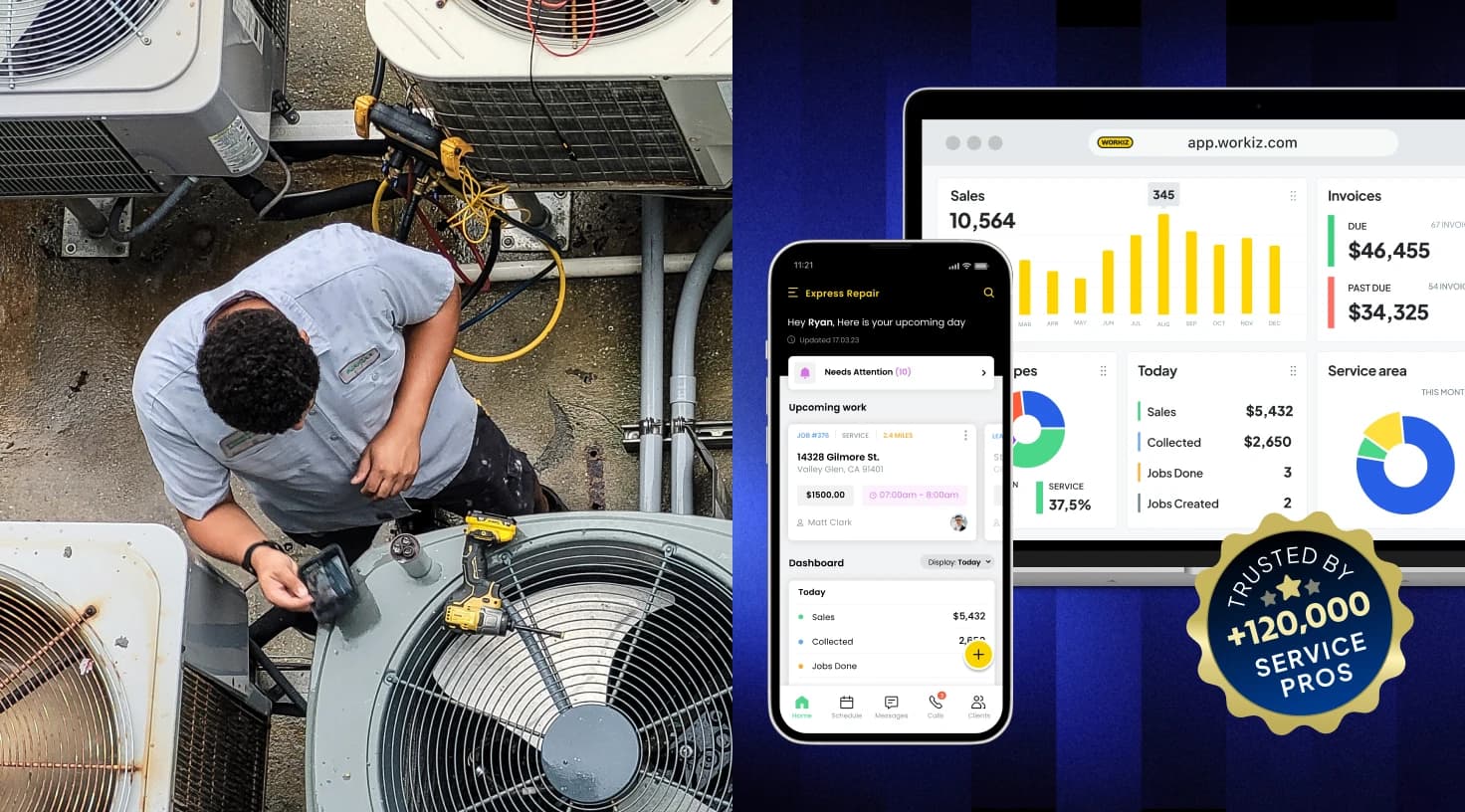
Once your strategy is in place, you need the right infrastructure to execute it effectively. In 2026, manual paperwork and fragmented communication often lead to lost revenue and compliance risks. Consequently, industry leaders rely on Workiz, the premier field service management platform built specifically for HVAC contractors.
Maximize operational efficiency
Workiz acts as a central hub for your entire operation. Therefore, you can focus on scaling your business while the software handles the logistical heavy lifting.
Intelligent dispatching: You can assign the right technician to the right job based on their specific North Carolina license classification.
Advanced business reporting: Gain full visibility into your North Carolina operations. Track technician performance, monitor job profitability, and identify your most lucrative service areas with real-time data. Furthermore, these insights empower you to make informed decisions for sustainable scaling.
Inventory management: Track high-cost parts, such as heat pumps and A2L refrigerants, in real-time across multiple service trucks.
Streamlined financial workflow: Generate professional estimates and automate invoicing to ensure faster payments and healthier cash flow.
Build a competitive edge in North Carolina
The Tar Heel State market is increasingly competitive. Consequently, your business must offer a superior customer experience to secure long-term contracts. Workiz provides integrated GPS routing to optimize travel times across North Carolina's diverse geography, from the Research Triangle to the coast. Furthermore, the specialized customer portal allows you to share real-time job updates and automated " On My Way " notifications.
Workiz empowers you to eliminate administrative bottlenecks and focus on skilled mechanical work. By adopting this professional-grade tool, you provide your growing firm with the infrastructure needed to dominate the North Carolina HVAC market.
Conclusion: Building a thriving HVAC business in North Carolina
Securing your North Carolina HVAC license is more than a regulatory hurdle. It is a strategic gateway to professional excellence and long-term financial stability. From mastering the specific license classifications to leveraging reciprocity agreements, every step in this process strengthens your company's foundation. Furthermore, maintaining an active status through the North Carolina HVAC license lookup tool ensures your firm remains compliant and ready for high-ticket contracts.
As the state's construction sector continues to surge, particularly in hubs like Charlotte and the Research Triangle, licensed contractors face unprecedented demand. Therefore, staying ahead requires a dual commitment to technical mastery and operational efficiency. By adopting professional-grade tools like Workiz and committing to continuous education, you position your business to dominate the competitive Tar Heel State market.
Your license validates your expertise and serves as the catalyst for sustainable growth. Consequently, you should prioritize your application today to secure your firm's future in 2026 and beyond. For the latest regulatory updates and forms, ensure you bookmark the official PHS Board website.